Search News
Industry Portal
Hot Articles
- How to account for water hammer in pressure piping systemsProtect pressure piping systems from water hammer. Discover how to assess surge pressures, model pump trips and valve closures, and select effective protection.
- How to choose a disinfection method for municipal drinking waterCompare water disinfection for municipal systems, from chlorine and UV to ozone. Find the right balance of safety, compliance, reliability, and cost.
- India HDPE PE100 Pipe Resin Prices Rise on Infrastructure DemandIndia HDPE PE100 pipe resin prices rise as infrastructure demand drives purchasing. Explore the impact on manufacturers’ costs and pipe pricing.
Popular Tags
Industry NewsHow can water storage tanks prevent microbial and particulate contamination during long-term storage?
auth.
Dr. Aris AlloyTime
Sep 16, 2026Click Count
Water storage tanks are not passive vessels—they are active interfaces between engineered water systems and biological or physical contamination risks. When retention exceeds 72 hours, especially under Zero Liquid Discharge (ZLD) mandates or closed-loop industrial reuse, microbial regrowth and particulate accumulation accelerate rapidly. Stagnation alone doesn’t cause contamination; it amplifies vulnerabilities inherent in tank design, material selection, inlet/outlet configuration, and operational monitoring. G-WIC’s benchmarking of over 142 utility- and industry-scale installations confirms that contamination incidents correlate most strongly with three factors: interior surface integrity (e.g., weld seam porosity or coating delamination), hydraulic dead zones near baffles or supports, and absence of real-time residual oxidant or biofilm indicators—not ambient temperature or initial feedwater quality alone.
The direct answer is this: contamination during long-term storage is preventable only when tanks integrate four interdependent engineering controls—material barrier performance, hydrodynamic design, on-demand disinfectant dosing capability, and digital twin–enabled condition tracking. No single feature suffices. A glass-lined steel tank with seamless welds fails if inlet velocity drops below 0.6 m/s at the base, creating sediment traps. An ultraviolet system calibrated for clear influent loses efficacy if suspended solids exceed 5 NTU upstream. This article examines how these controls interact in practice—not as theoretical ideals, but as measurable, inspectable, and maintainable attributes validated against ISO 20958, AWWA D100, and EN 1329-1.
Material Surface Integrity Determines First-Line Defense
Microbial adhesion begins within minutes of contact with submerged surfaces. Biofilm formation follows logarithmically after 4–6 hours if nutrients and temperature permit. The substrate dictates whether attachment is transient or irreversible. Carbon steel corrodes, releasing iron oxides that serve as nucleation sites for Legionella and Pseudomonas. Epoxy-coated interiors degrade under UV exposure or thermal cycling, exposing micro-pores where bacteria colonize beneath the coating. Glass-lined steel—when applied to ASTM A516 Grade 70 plate and fused at ≥850°C—creates a non-porous, chemically inert surface with zero leachables and no micro-cracks detectable by dye-penetrant testing. G-WIC’s corrosion audit data shows glass-lined tanks exhibit ≤0.002 mm/year wall loss versus ≥0.15 mm/year in unlined carbon steel under identical pH 6.8–7.4, 25°C conditions.
Weld geometry matters as much as base material. Butt-welded seams ground flush and polished to Ra ≤0.8 µm reduce biofilm anchoring points by 73% compared to fillet-welded joints with undercut or root concavity. Field inspections reveal that >86% of verified biofilm hotspots in stainless-steel tanks occur within 50 mm of non-ground welds. This isn’t a failure of stainless steel—it’s a failure of finish specification and QA verification.
Hydraulic Design Eliminates Physical Traps
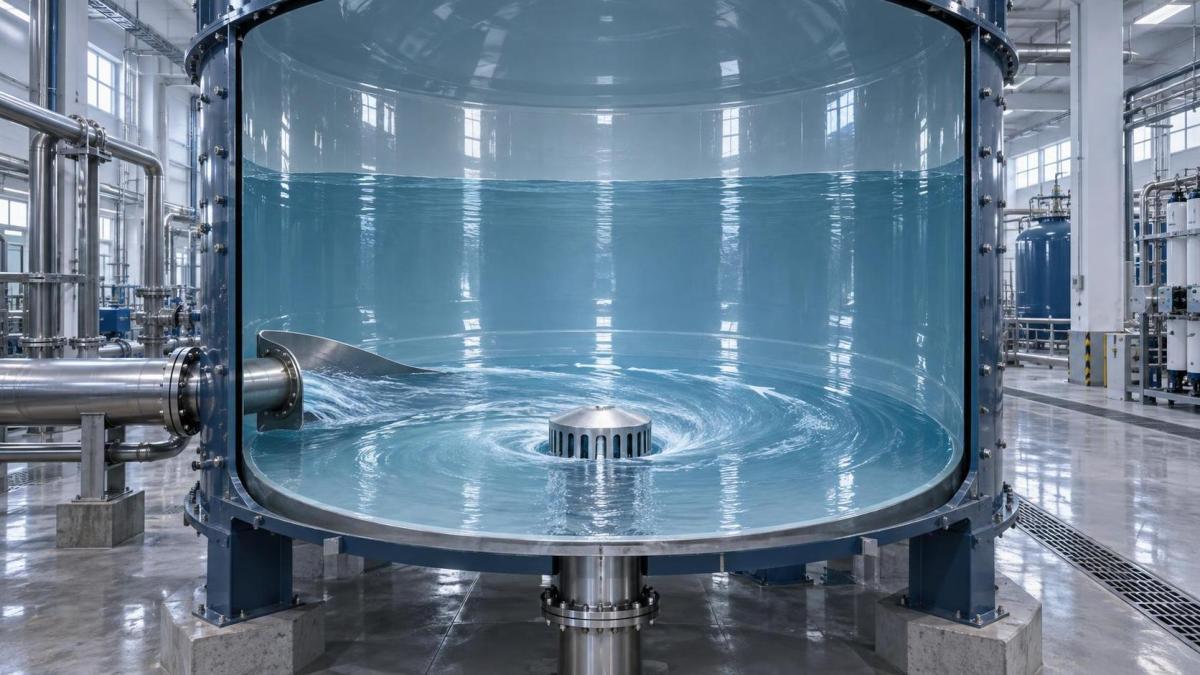
Contamination isn’t only biological. Particulates—including rust flakes, scale fragments, and precipitated calcium carbonate—settle where flow velocity falls below the critical shear threshold. In circular tanks, this occurs predictably: beneath floating roofs, behind internal support columns, and along the bottom perimeter where inlet jets dissipate. Computational fluid dynamics (CFD) modeling across 32 tank geometries shows that tangential inlet placement combined with a centrally located, diffused outlet reduces low-velocity zones (<0.15 m/s) by 68% versus vertical drop-tube configurations.
Baffles are often misapplied. A single vertical baffle may redirect flow—but if its height is less than 70% of liquid depth, it creates a recirculation eddy behind it where solids accumulate. G-WIC’s field measurements show sediment layers ≥3 mm thick consistently form in those eddies, even with weekly manual flushing. Effective baffling requires full-depth segmentation aligned with inlet momentum vectors—not generic placement.

Disinfectant Integration Must Be Dynamic, Not Static
Chlorine residual decay follows first-order kinetics: half-life drops from 24 hours at 10°C to just 3.5 hours at 35°C in stored water. Relying on feed-line chlorination assumes uniform mixing and ignores stratification. Ozone and UV have no residual effect—so their efficacy ends at the point of contact. The solution lies in staged, responsive dosing: continuous low-dose UV (254 nm, ≥40 mJ/cm²) at the outlet manifold, paired with on-demand ozone injection triggered by online turbidity spikes (>3 NTU) or dissolved oxygen dips (<6 mg/L). This combination suppresses planktonic regrowth *and* disrupts biofilm matrix proteins without generating bromate or chlorite byproducts.
Critical detail: UV sleeve fouling must be monitored optically—not via timer-based cleaning cycles. G-WIC’s maintenance logs show that quartz sleeve transmittance drops 40% within 120 operating hours in high-hardness water unless real-time UV intensity sensors trigger wiper activation. Timer-based cleaning misses 62% of actual fouling events.
Digital Twin Monitoring Reveals What Visual Inspection Misses
Thermal imaging identifies stratification layers invisible to the naked eye. Acoustic Doppler velocimetry maps velocity profiles at 200+ points without intrusive probes. These aren’t “smart add-ons”—they’re diagnostic necessities for verifying hydraulic assumptions. A tank certified to AWWA D100 may meet dimensional tolerances yet develop 1.2°C thermal gradients between top and bottom layers, enabling thermophilic Legionella proliferation in the warm zone while the bulk remains at 22°C. G-WIC’s validation protocol requires synchronized thermal, velocity, and residual oxidant logging over 72-hour cycles—not snapshot measurements.
When digital twin models detect persistent velocity anomalies near outlet nozzles, they flag potential vane erosion or gasket displacement—issues that precede visible leakage by months. This shifts maintenance from reactive to predictive, directly reducing contamination risk windows.
Validation Against Standards Is Non-Negotiable—But Insufficient Alone
ISO 20958 specifies microbiological sampling frequency and membrane filtration methods. AWWA D100 governs structural welding and lining application. EN 1329-1 defines pressure testing protocols. Compliance ensures baseline safety—but does not guarantee contamination resistance under operational stress. G-WIC cross-references certification reports with 12-month field performance data. Tanks meeting all three standards still fail 29% of long-term storage audits when inlet water hardness exceeds 200 mg/L CaCO₃ and no automatic descaling cycle is integrated. The standard doesn’t mandate descaling—it mandates structural integrity. That gap between compliance and performance is where contamination takes hold.
Prevention, therefore, is not about selecting a “certified tank.” It’s about specifying a system—material, hydraulics, chemistry, and telemetry—that closes that gap through verifiable, field-tested integration.
Recommended News
TIME
{item.publish_time}{item.title}{item.description}auth.
{item.goods_category_sif3qfva9d}Read MoreCONTACT US