Search News
Industry Portal
Hot Articles
- How to evaluate a ZLD systems supplier for variable wastewater loadsChoose a ZLD systems supplier ready for variable wastewater loads. Learn how to assess operating flexibility, pilot evidence, costs, and guarantees to reduce risk and buy with confidence.
- How MWCO affects contaminant retention in pressurized UF systemsPressurized UF MWCO influences contaminant retention, flux, fouling, and downstream protection. Learn how to select the right cut-off for reliable water treatment performance.
- When does thermal drying make sense for biosolids sludge management?Biosolids Sludge Management: discover when thermal drying cuts transport costs, improves pathogen control, and creates reliable end-use value.
Popular Tags
Industry NewsC25 Ductile Iron Pipe vs Other Pressure Classes in Project Selection
auth.
Dr. Victor GearTime
Jul 31, 2026Click Count
C25 Ductile Iron Pipe vs Other Pressure Classes in Project Selection
Pressure class selection is one of the decisions that can quietly shape the long-term performance, installation cost, and operational reliability of a pipeline project. In water supply, municipal transmission, industrial utility networks, and replacement programs, teams often focus first on diameter, route, and delivery schedule. Yet the pressure class of ductile iron pipe deserves equal attention because it affects how well the system handles internal pressure, external loads, surge conditions, and maintenance demands over time.
Among the available options, C25 is frequently assessed for projects that need a balanced solution rather than the highest possible wall thickness. It sits in a practical middle ground for many engineers and buyers who are trying to control total project cost without under-specifying the system. The issue is not whether one class is universally better than another. The real question is how C25 compares with other pressure classes when actual site conditions, operating requirements, safety margins, and procurement constraints are taken into account.
For technical evaluators and procurement teams, this topic matters because class selection influences more than material purchase price. It can affect transport weight, handling efficiency, joint performance, trench design coordination, inspection priorities, and even the pace of installation. A class that looks economical on paper may create avoidable risk if surge conditions, burial depth, or future network expansion are not considered early enough.
In many project reviews, the comparison starts with operating pressure, but that should only be the first layer. Ductile iron pipelines work in environments where static pressure, transient pressure, soil conditions, traffic loading, and construction quality all interact. A lower class may be suitable in stable conditions with disciplined installation controls. A higher class may be justified where uncertainty is greater, where system shocks are likely, or where asset owners want additional conservatism for long service life.
Why Class Selection Has Become More Important
Infrastructure owners are under pressure to build networks that remain dependable under tighter budgets and higher accountability. That has made material choice more data-driven. Instead of selecting pipe class by habit or by copying old specifications, many organizations now review hydraulic behavior, installation environment, lifecycle risk, and supplier consistency in a more structured way.
This shift is especially relevant in rehabilitation and network extension projects. Existing systems may have uneven operating histories, unknown surge events, or mixed-material connections. In such settings, a pressure class decision must support both current performance and reasonable future flexibility. Choosing too high a class across the entire route may increase cost and weight beyond what the project really needs. Choosing too low may narrow the safety margin in ways that only become visible after commissioning.

How C25 Compares with Other Pressure Classes
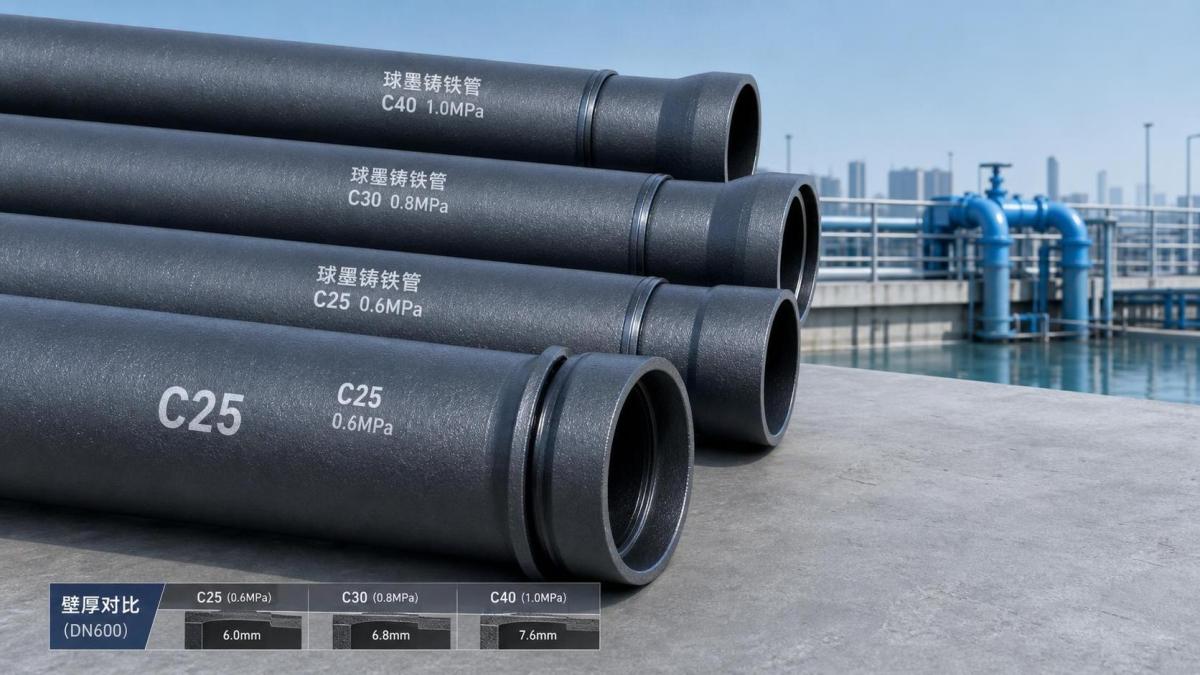
C25 is often evaluated against lighter and heavier class alternatives in projects where designers need a measured balance between structural confidence and procurement efficiency. In general terms, moving to a higher class usually means greater wall thickness and a stronger reserve against pressure and loading conditions, but it also tends to increase unit weight and material cost. Moving to a lower class may improve handling and reduce upfront spending, but only if the service environment is clearly understood and controlled.
That is why C25 ductile iron pipe is commonly discussed in project planning as part of a broader class-selection review rather than as a stand-alone item. For many buyers, the value lies in whether it aligns with system pressure, burial conditions, joint selection, and expected operating discipline. In practical terms, C25 can be attractive when the project requires dependable performance under routine municipal or industrial service conditions but does not automatically justify the added mass and cost of a heavier class throughout the entire line.
The comparison should also reflect how pressure class interacts with construction reality. If a project involves variable trench quality, uncertain bedding control, or a route exposed to traffic and ground movement, technical teams may lean toward a more conservative class. If the route conditions are stable, the installation standard is well controlled, and the hydraulic profile is predictable, C25 may represent a more proportionate specification.
Key Decision Criteria for Engineers and Buyers
A useful class decision usually comes from cross-functional review rather than from a single design parameter. Engineering, procurement, quality, and commercial teams often look at the same pipe through different lenses. Bringing those viewpoints together reduces the chance of avoidable mismatch between specification and field conditions.
- Operating and surge pressure: Normal working pressure is important, but transient events may be equally important in pump-driven or valve-sensitive systems.
- Burial and external loading: Deep cover, heavy traffic, unstable soil, and backfill quality can change the risk profile significantly.
- Installation capability: Heavier classes may require more handling effort and tighter logistics, while lighter options may demand stricter control of field conditions.
- Lifecycle maintenance strategy: Asset owners often consider not only initial compliance, but also inspection access, repair exposure, and operational tolerance over time.
- Supply consistency: Even an appropriate class choice can create problems if dimensional quality, coating consistency, or documentation control are weak.
For procurement personnel, one practical lesson is that the cheapest line item is not always the most economical project outcome. A class that reduces material cost but introduces higher installation sensitivity or lower operational tolerance may shift cost into rework, delays, or maintenance exposure. Commercial evaluations should therefore be linked to technical acceptance criteria and supplier quality assurance, not handled as a separate exercise.
Common Mistakes in Pressure Class Comparison
One common mistake is treating all pipeline sections as if they face identical service conditions. In many real projects, the route includes segments with different elevations, traffic exposure, or connection complexity. Uniform class selection can simplify purchasing, but it may also lead either to unnecessary overspecification or to hidden weak points. Segment-based review may produce a more rational result.
Another mistake is focusing only on nominal pressure values without reviewing water hammer risk, shutoff behavior, or emergency operating scenarios. Systems that appear moderate in routine operation may still face short-duration stress events that affect class suitability. Technical teams should also avoid assuming that a heavier class compensates for weak installation practice. Pipe class improves margin, but it does not replace proper bedding, joint assembly, alignment, and trench control.
Quality and safety managers often point to a further issue: insufficient verification of manufacturing consistency. Class designation is meaningful only when the supplied product meets the specified dimensional, mechanical, and protective requirements. Documentation review, inspection planning, and acceptance checks remain essential regardless of which class is selected.
Typical Use Cases Where C25 May Be Considered
C25 may be considered in municipal distribution and transmission works where the operating regime is well understood and the project team needs a practical compromise between strength and material efficiency. It can also fit network expansion projects in industrial parks, utility corridors, and regional infrastructure upgrades where designers want a durable ductile iron solution but are not facing the most extreme pressure or loading environment across the whole route.
In replacement projects, C25 may also enter the discussion when legacy systems are being modernized and stakeholders want to standardize around a class that supports routine operational confidence without moving directly to the highest available specification. In these cases, the final decision often depends on route-specific checks such as pressure fluctuation, soil behavior, and installation access rather than on a single generic rule.
A Practical Comparison Framework
Using a framework like this helps organizations avoid class selection based on habit alone. It also improves communication between design reviewers and commercial teams, who may otherwise prioritize different outcomes. A technically suitable class should perform reliably in service while also fitting the project’s budget, schedule, and quality controls.
What Decision-Makers Should Prioritize
For information researchers, the priority is understanding where C25 sits in relation to operating demands rather than treating it as a default specification. For technical evaluators, the priority is validating whether the class matches both pressure conditions and real installation exposure. For procurement and commercial teams, the key issue is total project value, including logistics, delivery reliability, and the risk cost of under- or over-specification. For quality and safety personnel, the focus remains supplier control, inspection discipline, and field execution quality.
The strongest project outcomes usually come from disciplined matching rather than from extreme choices. C25 may be the right answer in many balanced service environments, while higher or lower classes may better suit routes with different risk profiles. What matters is that the decision is tied to verifiable operating conditions, installation capability, and long-term asset expectations.
In project selection, pressure class is not just a technical label. It is a procurement and risk-management choice that affects cost, reliability, and accountability across the pipeline lifecycle. Comparing C25 with other classes through a practical, cross-functional lens gives decision-makers a clearer basis for selecting a pipe specification that supports both immediate project goals and durable system performance.
Recommended News