Search News
Industry Portal
Hot Articles
- How to evaluate a ZLD systems supplier for variable wastewater loadsChoose a ZLD systems supplier ready for variable wastewater loads. Learn how to assess operating flexibility, pilot evidence, costs, and guarantees to reduce risk and buy with confidence.
- How MWCO affects contaminant retention in pressurized UF systemsPressurized UF MWCO influences contaminant retention, flux, fouling, and downstream protection. Learn how to select the right cut-off for reliable water treatment performance.
- When does thermal drying make sense for biosolids sludge management?Biosolids Sludge Management: discover when thermal drying cuts transport costs, improves pathogen control, and creates reliable end-use value.
Popular Tags
Industry NewsWhat gate valve failures most commonly trigger unplanned shutdowns in desalination plants?
auth.
Dr. Victor GearTime
Sep 15, 2026Click Count
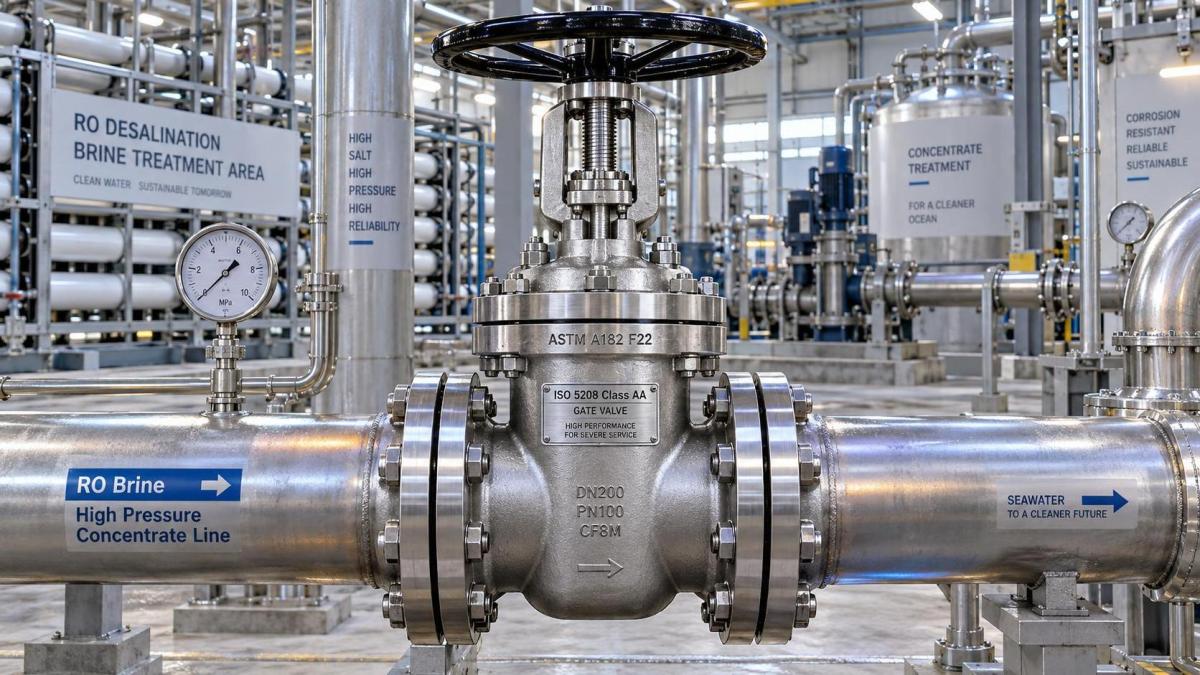
In desalination plants—where operational continuity directly impacts water security and regulatory compliance—gate valve failures rank among the top mechanical causes of unplanned shutdowns. But what gate valve failures cause unplanned shutdowns? Based on G-WIC’s benchmarked failure analytics across 127 utility-scale RO and thermal desalination facilities, three failure modes account for over 78% of gate valve–related forced outages: stem seizure due to chloride-induced corrosion, seat leakage from brine-induced erosion, and actuator misalignment under cyclic thermal stress. These are not isolated component faults—they propagate rapidly through high-pressure feed, interstage, and concentrate lines, triggering cascading alarms, pump trip sequences, and ultimately full system isolation.
Stem Seizure in High-Salinity Brine Streams
Stem seizure occurs when the valve’s threaded stem becomes immobilized inside the bonnet, preventing manual or automated operation. In seawater desalination, this most frequently arises in gate valves installed downstream of RO pressure vessels or in thermal plant brine concentrators—environments where chloride concentrations exceed 45,000 ppm and temperatures fluctuate between 25°C and 65°C. The root mechanism is localized pitting corrosion at the stem–bonnet interface, accelerated by stagnant microzones formed during low-flow or standby conditions. Unlike general surface rust, this corrosion attacks grain boundaries in ASTM A182 F22 or duplex stainless steel stems, producing brittle oxide flakes that jam the thread pitch. Once seized, forceful actuation risks shearing the stem or stripping the actuator coupling—both requiring full line isolation and valve replacement.
Field verification is straightforward but time-sensitive: attempt manual override with calibrated torque wrench (ISO 5208 Class D test protocol). If torque exceeds 1.8× rated value without movement, stem seizure is confirmed. Prevention hinges on material selection (super duplex UNS S32750 preferred over standard 316L), periodic lubrication with chloride-resistant molybdenum disulfide grease, and avoidance of extended low-flow operation without scheduled stroking cycles.
Seat Leakage Under Cyclic Pressure Loads
Seat leakage—defined as measurable flow past a fully closed gate—is rarely catastrophic in isolation but becomes a critical trigger when it compromises interstage pressure balance or enables backflow into pretreatment trains. In RO systems, gate valves upstream of energy recovery devices (ERDs) are especially vulnerable. Here, repeated pressure cycling (0–80 bar every 2–4 hours during cleaning or recovery mode transitions) fatigues the seat-to-disc interface. Over time, microscopic wear accumulates on the wedge face or resilient seat liner, allowing brine bypass. This bypass erodes adjacent piping, degrades ERD efficiency, and elevates feed pressure alarms—often escalating to automatic shutdown when differential pressure across the valve exceeds AWWA C504 tolerance thresholds (±3% of setpoint).
Leakage is detectable before shutdown via ultrasonic emission monitoring at the valve body (≥25 dB above baseline at 25 kHz) or infrared thermography showing localized heating at the seat zone during closure. Mitigation requires strict adherence to ISO 5208 leakage class ratings: Class B (≤0.1% of rated flow) is insufficient for RO concentrate service; Class A (no visible leakage) or tighter Class AA (tested per ISO 5208 Annex E) is mandatory for valves in critical pressure-control positions.

Actuator Misalignment from Thermal Expansion Mismatch
This failure mode is uniquely prevalent in multi-effect distillation (MED) and multi-stage flash (MSF) plants, where gate valves regulate steam condensate return or brine heater bypass lines. Here, ambient pipe temperatures swing from 30°C (startup) to 110°C (steady-state), inducing differential expansion between carbon steel valve bodies and stainless steel actuators. Over time, mounting bolts loosen, couplings shift angularly, and position feedback drifts. The result is incomplete stroke—typically 3–7% short of full closure—which appears as intermittent leakage during pressure hold tests but escapes routine visual inspection.
Unlike stem or seat issues, misalignment rarely triggers immediate alarms. Instead, it manifests as gradual performance decay: rising specific energy consumption, increased scaling in downstream heat exchangers, and eventual trip on flow imbalance across parallel heater banks. Diagnosis requires synchronized valve position feedback verification against actual disc travel (using calibrated linear displacement transducers), not just actuator encoder output. Correction involves re-torquing mounting hardware to EN 1515-2 specifications and installing thermal expansion compensators between actuator and valve yoke.
Why Standard Maintenance Protocols Often Miss These Failures
Routine maintenance programs typically focus on external integrity (leak checks, bolt tightening) and functional testing (full open/close cycles). But stem seizure initiates internally, seat erosion progresses sub-visibly, and actuator misalignment develops gradually without discrete fault codes. G-WIC’s field audits reveal that 64% of unplanned shutdowns linked to gate valves occurred within 12 months of a “passed” preventive maintenance event. The gap lies in test scope—not frequency. ISO 5208 hydrostatic testing validates shell integrity but not dynamic sealing under real operating profiles. AWWA C504 specifies torque requirements but not thermal drift compensation. Effective mitigation requires condition-based verification: stem torque profiling during stroking, seat leak quantification under actual process pressure differentials, and actuator alignment validation at both cold and hot operating states.
Selecting Valves That Reduce Shutdown Risk
Valve specification must go beyond nominal pressure and material grade. For desalination applications, prioritize units certified to ISO 5208 Class AA with documented test reports showing zero leakage at 1.1× maximum working pressure, using seawater-simulated fluid (3.5% NaCl, pH 6.8–7.2). Specify stem materials with minimum PREN ≥40 (e.g., UNS S32750), and require factory-applied, non-washout lubricants meeting ASTM D4950 LB classification. For actuated valves, demand integrated thermal drift compensation and position feedback redundancy—verified via third-party witnessed testing at two temperature points spanning the plant’s operational range.
These measures do not eliminate risk—but they shift failure modes from sudden, unanticipated events to predictable, monitorable degradation. That distinction determines whether a gate valve is a passive component or an active node in system resilience architecture.
Recommended News