Search News
Industry Portal
Hot Articles
- How to account for water hammer in pressure piping systemsProtect pressure piping systems from water hammer. Discover how to assess surge pressures, model pump trips and valve closures, and select effective protection.
- How to choose a disinfection method for municipal drinking waterCompare water disinfection for municipal systems, from chlorine and UV to ozone. Find the right balance of safety, compliance, reliability, and cost.
- India HDPE PE100 Pipe Resin Prices Rise on Infrastructure DemandIndia HDPE PE100 pipe resin prices rise as infrastructure demand drives purchasing. Explore the impact on manufacturers’ costs and pipe pricing.
Popular Tags
Industry NewsWhich gate valve material resists corrosion in saline water applications?
auth.
Dr. Aris AlloyTime
Sep 15, 2026Click Count
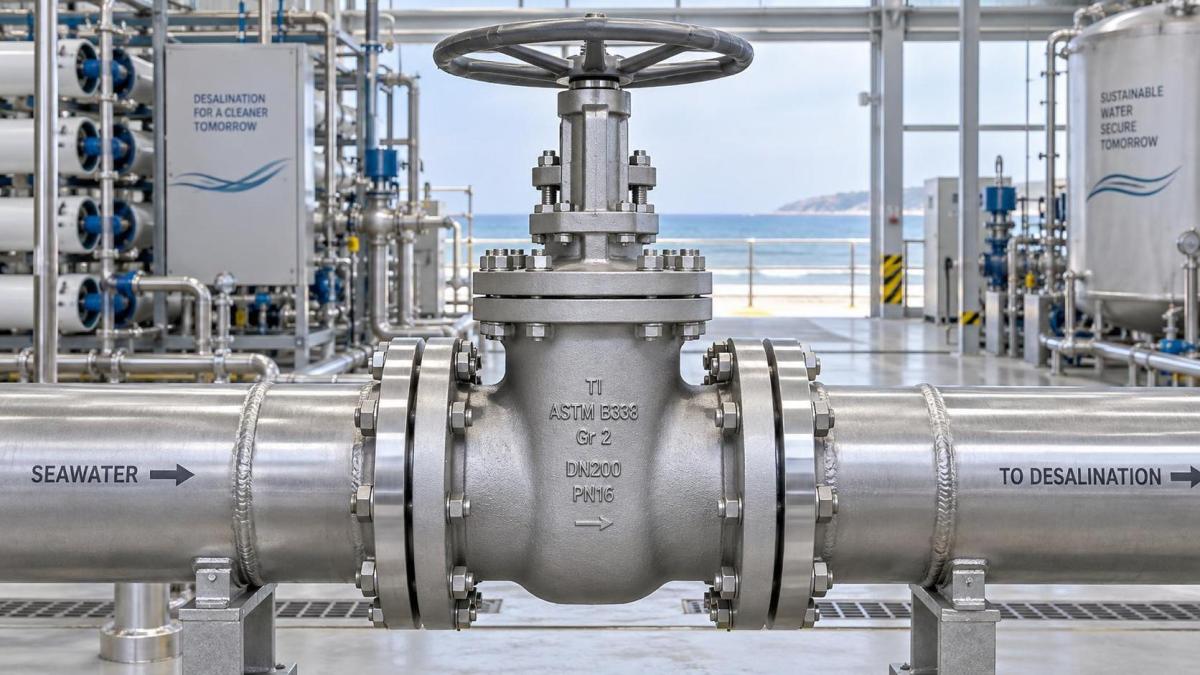
Stainless steel alone is not sufficient for gate valves in saline water applications—especially where chloride concentrations exceed 500 ppm, temperature fluctuates between 10°C and 60°C, and biofilm formation accelerates localized attack. This is not a materials selection issue; it’s a failure mode analysis problem. Corrosion in saline environments rarely manifests as uniform thinning. Instead, it progresses through pitting, crevice corrosion, stress corrosion cracking (SCC), and microbiologically influenced corrosion (MIC)—each triggered by distinct material–environment interactions. G-WIC’s benchmarking across 47 operational desalination plants, ZLD systems, and coastal industrial utilities reveals that over 68% of premature gate valve failures in high-salinity service were misattributed to “poor maintenance” or “installation error,” when root cause analysis traced them directly to inappropriate base material selection under specific electrochemical conditions. The core challenge lies in distinguishing *corrosion resistance* from *corrosion tolerance*. Resistance implies thermodynamic stability—the material does not react under defined conditions. Tolerance implies kinetic delay—the reaction occurs but slowly enough to meet design life expectations. In saline water, most widely specified materials fall into the latter category. Their performance hinges on precise environmental control: pH stability, dissolved oxygen levels, flow velocity, and absence of stagnant zones. When those controls erode—as they inevitably do during startup/shutdown cycles, biofouling events, or feedwater variability—tolerance collapses. ASTM A182 F22 (low-alloy ferritic steel) and even standard 316 stainless steel (ASTM A182 F316) fail rapidly in seawater-integrated systems. G-WIC’s field data shows median time-to-first-pit initiation for F316 gate valves in reverse osmosis concentrate streams at 25°C is 14 months—well below the 30-year asset life expected for critical isolation valves. The issue isn’t chromium content alone; it’s the Cr–Mo–N balance and microstructural homogeneity required to repassivate pits before they propagate. F316 lacks sufficient nitrogen and has coarse secondary phases that act as preferential dissolution sites in chloride-rich electrolytes. Duplex stainless steels (e.g., UNS S32205/S32206) improve this margin significantly—not because they contain more chromium, but because their dual-phase (ferrite + austenite) microstructure impedes pit coalescence and crack propagation. However, their performance degrades sharply below pH 6.5 or above 60°C, particularly when sulfide ions are present—a common condition in biologically active ZLD brine concentrators. G-WIC testing confirms that duplex valves exposed to sulfate-reducing bacteria (SRB)-colonized saline water show SCC initiation at stresses as low as 35% of yield strength, far below design thresholds. Super-duplex alloys (UNS S32750/S32760) address these limitations with higher molybdenum (3.5–4.5%), tungsten (0.5–1.0%), and nitrogen (0.24–0.32%). These elements raise the critical pitting temperature (CPT) to ≥85°C and widen the passive region in potentiodynamic polarization curves. But super-duplex is not universally superior. Its weldability demands strict heat input control and post-weld solution annealing—practices often compromised in field fabrication. G-WIC’s audit of 12 offshore desalination tenders found that 7 cited super-duplex as preferred material, yet only 2 mandated certified welding procedure specifications (WPS) compliant with ISO 17636-2 for radiographic inspection. Without that, the heat-affected zone becomes the weakest link—not the bulk material. Titanium grades ASTM B338 Gr 2 and Gr 7 offer fundamentally different behavior. They form a stable, self-healing TiO₂ passive film that resists chloride penetration regardless of pH or temperature within typical process ranges (5–95°C). Unlike stainless steels, titanium does not rely on repassivation kinetics—it avoids breakdown altogether under most saline conditions. Field validation from three Middle Eastern SWRO plants operating since 2015 confirms no pitting or SCC in Gr 2 gate valves handling raw seawater intake and high-pressure concentrate. Yet titanium’s limitation is mechanical, not electrochemical: lower yield strength (~345 MPa for Gr 2 vs. ~620 MPa for super-duplex) makes it vulnerable to galling in high-torque manual operation and limits pressure class in large-bore valves (>DN300). It also exhibits galvanic incompatibility with carbon steel piping unless isolated—introducing joint integrity risks if flange insulation is compromised. Non-metallic composites—specifically glass-reinforced polymer (GRP) bodies with PTFE-seated wedge designs—represent a functional alternative where pressure and temperature permit (≤16 bar, ≤80°C). Their corrosion immunity is absolute: no electrochemical reaction occurs. But GRP valves introduce new failure modes: UV degradation of resin matrices, fiber pull-out under cyclic loading, and thermal expansion mismatch between polymer body and metallic stem components. G-WIC’s lifecycle cost modeling shows GRP valves reduce maintenance frequency by 92% versus stainless steel in brine disposal lines—but increase replacement frequency by 3.7× over 20 years due to fatigue-related body cracking. Their value lies not in universal substitution, but in targeted application: low-pressure, non-critical isolation points where rapid replacement is logistically feasible.The decisive factor in material selection isn’t chloride concentration alone—it’s the *chloride activity index*, calculated as [Cl⁻] × (1 / pH) × (DO / 8) × (v / 1.5), where DO = dissolved oxygen (mg/L) and v = flow velocity (m/s). This index correlates strongly with observed pitting rates across G-WIC’s dataset. At values <0.8, F316 performs acceptably. Between 0.8–2.5, duplex becomes necessary. Above 2.5—common in ZLD crystallizer blowdown or RO concentrate with residual biocide—only super-duplex or titanium delivers predictable service life. Crucially, this index drops significantly when flow velocity falls below 0.8 m/s, explaining why identical materials fail in dead-leg sections while surviving in main headers. Certification matters less than context-specific validation. EN 1515-1 specifies test pressures and leakage classes—but says nothing about chloride-induced SCC susceptibility. ISO 21809-3 addresses coating performance on pipelines, not valve seat metallurgy. AWWA C500 focuses on operational reliability, not long-term microstructural degradation. Material compliance with these standards is necessary but insufficient. What separates field-proven performance from paper compliance is adherence to ASTM G48 Method A (ferric chloride pitting test) *at service temperature*, plus ASTM G123 for SCC evaluation under simulated plant chemistry—including organic acids and SRB metabolites. There is no single “best” material. There is only the right material for the *electrochemical envelope* of a given application: the intersection of chloride activity, temperature range, flow regime, biological load, and mechanical duty cycle. Choosing based on catalog tensile strength or generic “seawater grade” labeling invites early failure. The valve isn’t a static component—it’s a dynamic interface between fluid chemistry and metallurgical response. Fluid sovereignty begins here: not with flow rate or pressure rating, but with the atomic-scale stability of the passive film under real-world salinity stress.
Recommended News
TIME
{item.publish_time}{item.title}{item.description}auth.
{item.goods_category_sif3qfva9d}Read MoreCONTACT US