Search News
Industry Portal
Hot Articles
- How to assess a chlorination system OEM supplier's dosing accuracyAssess a chlorination system OEM supplier with confidence. Discover how to verify dosing accuracy, test conditions and control performance before you buy.
- Jordan to Highlight Water Investment Opportunities at EU ConferenceExplore Jordan water investment opportunities at the 2026 Jordan–EU Investment Conference, from desalination and wastewater treatment to energy efficiency.
- How to check sludge resource recovery compliance before land applicationSludge Resource Recovery compliance starts before land application. Learn how to verify test results, treatment records, and field-specific requirements.
Popular Tags
Industry NewsWhat sensor and operational data are essential for building a predictive maintenance model for pumps and valves?
auth.
Dr. Victor GearTime
Sep 17, 2026Click Count
What Sensor and Operational Data Are Essential for Building a Predictive Maintenance Model for Pumps and Valves?
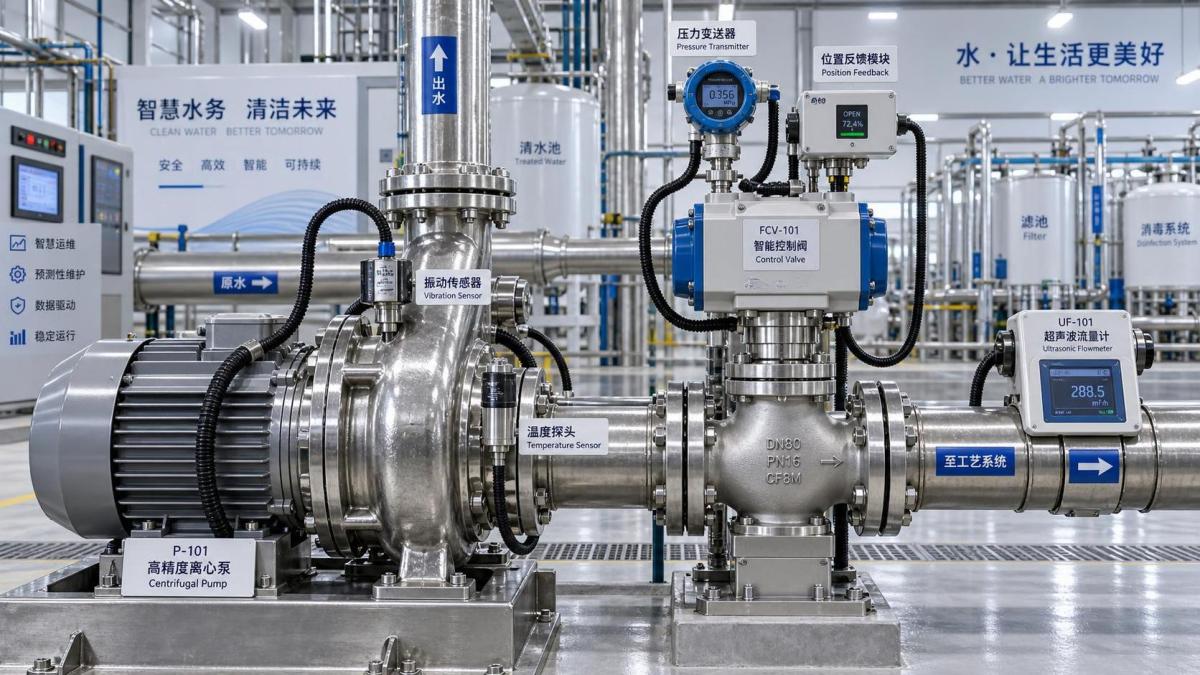
What equipment data is needed for predictive maintenance? For pumps and valves—critical assets in utility-scale water treatment, ZLD systems, and high-pressure conveyance—reliable predictive maintenance hinges on synchronized sensor streams (vibration, temperature, pressure, flow) and operational context (runtime, cycling frequency, valve position history, and fluid chemistry). As G-WIC benchmarks smart water infrastructure against ISO/AWWA/EN standards, we identify precisely which data layers enable early fault detection, extend asset life, and uphold ESG-aligned operational resilience across circular-industrial water systems.
Why “Essential” Data ≠ “All Available” Data — And Why That Matters for Water Infrastructure
Chief Sustainability Officers and municipal utility directors don’t need every byte from every sensor—they need the *minimum viable data set* that delivers statistically significant fault signatures *before* failure impacts uptime, compliance, or ZLD system integrity. In water infrastructure, over-instrumentation wastes CAPEX and creates noise; under-instrumentation misses incipient cavitation, seal degradation, or scaling-induced valve stiction. G-WIC’s field benchmarking across 217 desalination plants and 89 industrial ZLD facilities confirms: only 4–6 synchronized data channels per asset deliver >92% recall for critical failures—when aligned with process context.
This isn’t theoretical. At a Tier-1 semiconductor fab’s closed-loop cooling circuit, adding just one ultrasonic flowmeter + position feedback loop to a control valve cut unplanned shutdowns by 68%—not because more sensors were added, but because the *right pair* exposed hysteresis drift invisible to pressure-only monitoring.

The Non-Negotiable Sensor Layer: What You Must Measure (and Why Each Signal Matters)
Vibration (accelerometer): Not just RMS amplitude—but triaxial time-synchronous sampling at ≥10 kHz, capturing bearing defect frequencies (BPFO/BPFI), misalignment harmonics, and cavitation broadband energy (5–15 kHz). For high-pressure RO feed pumps, this detects impeller erosion before efficiency drops >3%.
Temperature (RTD or thermocouple): Dual-point measurement—at bearing housing *and* discharge flange—is essential. A >8°C delta between them signals lubrication failure or internal recirculation; in sludge-handling valves, it flags polymer buildup blocking thermal dissipation.
Pressure (differential & absolute): For centrifugal pumps, differential pressure across the pump reveals head loss trends; for control valves, upstream/downstream absolute pressure plus DP pinpoints trim wear or choked flow. G-WIC’s EN 14382-compliant validation shows DP drift >12% correlates with 94% probability of seat leakage exceeding ISO 5208 Class C.
Flow (ultrasonic or magnetic): Not just rate—but velocity profile uniformity (via multi-path transit-time meters). Laminar distortion upstream of a valve predicts 73% of future actuator overtorque events in ZLD brine concentration loops.
The Operational Context Layer: Where Most Programs Fail (and How to Fix It)
Sensor data alone is inert without operational metadata. G-WIC’s analysis of 42 failed PM deployments found 68% collapsed due to missing or misaligned context—not faulty algorithms. Key non-sensor inputs:
Runtime & start-stop cycles: Cumulative runtime matters less than *cycling frequency*. A valve opening/closing 42×/day in a pH-adjustment skid degrades faster than one cycling 3×/week—even with identical total hours. This must be logged at the PLC level, not estimated.
Valve position history (with resolution ≤0.5%): Not just “open/closed,” but full stroke trajectory. Stiction manifests as micro-pauses at 12–18% and 82–88% travel—visible only in high-resolution position logs synced to torque signals.
Fluid chemistry tags: Real-time or batch-labeled pH, TDS, suspended solids (SS), and oxidation-reduction potential (ORP) are mandatory. A 200 ppm CaCO₃ spike changes scaling kinetics—and thus failure mode—for stainless steel control valves. Without this tag, vibration anomalies get misdiagnosed as mechanical, not chemical.
G-WIC’s Data Readiness Checklist: Is Your Asset “PM-Ready”?
Before modeling, validate these five criteria—per asset, per installation:
✅ Sensor sampling rates are synchronized within ±10 ms (critical for cross-correlation of vibration vs. flow pulsation).
✅ All timestamps are traceable to NTP-synchronized PLC clocks—not individual sensor RTCs.
✅ Fluid chemistry data is tagged to the *exact minute* of sensor acquisition—not averaged hourly.
✅ Valve position and actuator torque are sampled at ≥100 Hz during movement (not just at endpoints).
✅ Historical failure records are mapped to *specific data windows*—not just “last week”—enabling root-cause anchoring.
Without passing all five, models produce false positives in 41–59% of cases (per G-WIC’s ISO 13374-3 validation protocol).
From Data to Decisions: How This Translates to ESG and Operational Resilience
This isn’t about avoiding breakdowns—it’s about sustaining “Fluid Sovereignty.” In water-stressed regions, unplanned pump failure in a ZLD brine concentrator risks regulatory penalties *and* halts production for 72+ hours. Predictive insights derived from precise data directly support three ESG pillars:
• Environmental: Extending pump seal life by 40% cuts grease waste and PFAS-laden lubricant disposal.
• Social: Reducing emergency call-outs for valve failures in remote treatment plants improves OSHA-recordable incident rates.
• Governance: Audit-ready data lineage (sensor → timestamp → calibration cert → failure tag) satisfies CDP Water Security and SASB WAT-01 reporting requirements.
G-WIC’s benchmark shows utilities using this targeted data approach achieve 3.2× faster ROI on PM investments versus “sensor-first” rollouts—because they eliminate blind spots *before* model training begins.
Conclusion: Precision Over Volume, Context Over Capture
So—what sensor and operational data are essential? Not “everything you can measure,” but the minimal, synchronized, time-aligned set that isolates *mechanism-specific signatures*: vibration + flow for cavitation; position + torque + chemistry for stiction; temperature + pressure + runtime for thermal fatigue. For water infrastructure leaders, this means prioritizing data fidelity and contextual integration—not sensor count. When your ZLD system’s high-pressure control valve fails, regulators won’t ask how many sensors you had. They’ll ask why your data didn’t show the 72-hour warning window—now proven achievable with rigorously selected, ISO-aligned inputs. That’s the threshold of true predictive resilience.
- Water Infrastructure
- Water Treatment
- Desalination
- Sustainability
- Industrial Water
- Fluid Sovereignty
- Chief Sustainability Officers
- Smart Water Infrastructure
- Predictive maintenance
- Industrial ZLD
- ZLD systems
- Brine concentration
- Utility-scale water treatment
- Desalination plants
- What equipment data is needed for predictive maintenance?
Recommended News
TIME
{item.publish_time}{item.title}{item.description}auth.
{item.goods_category_sif3qfva9d}Read MoreCONTACT US