Search News
Industry Portal
Hot Articles
- How to account for water hammer in pressure piping systemsProtect pressure piping systems from water hammer. Discover how to assess surge pressures, model pump trips and valve closures, and select effective protection.
- How to choose a disinfection method for municipal drinking waterCompare water disinfection for municipal systems, from chlorine and UV to ozone. Find the right balance of safety, compliance, reliability, and cost.
- India HDPE PE100 Pipe Resin Prices Rise on Infrastructure DemandIndia HDPE PE100 pipe resin prices rise as infrastructure demand drives purchasing. Explore the impact on manufacturers’ costs and pipe pricing.
Popular Tags
Industry NewsHow to specify water treatment for industrial cooling tower use
auth.
Dr. Aris AlloyTime
Oct 17, 2026Click Count
Specify cooling tower water treatment around the water quality the system must maintain, the risks it must control, and the evidence required to demonstrate performance. A chemical package or filtration unit alone does not define a complete solution. Effective water treatment for industrial use connects makeup-water quality, operating conditions, equipment materials, monitoring, and discharge limits in one specification.
Begin with a practical question: under the most demanding expected conditions, can the proposed treatment keep heat-transfer surfaces clean, protect the system from corrosion, and control microbial growth without creating unacceptable wastewater or maintenance demands? The specification should make suppliers explain how their proposal meets those conditions.
Establish the design basis before requesting proposals
This guide focuses on open evaporative cooling systems, where evaporation concentrates dissolved substances and the circulating water is exposed to airborne contamination. A closed process loop connected to an evaporative cooler needs a separate treatment specification for its internal fluid circuit.
Provide suppliers with a representative makeup-water analysis and the expected range of variation. A single sample can miss seasonal changes, source switching, or fluctuations in reclaimed-water quality. Include the following information:
- Water chemistry: pH, conductivity, alkalinity, calcium and magnesium hardness, silica, chloride, sulfate, and relevant metals.
- Contamination indicators: suspended solids, turbidity, and organic or nutrient loading where reclaimed water or process contamination is possible.
- Operating conditions: circulation rate, heat load, supply and return temperatures, operating schedule, system volume, and expected shutdown periods.
- Materials and equipment: heat-exchanger metallurgy, piping, tower components, coatings, seals, and any manufacturer restrictions.
- Site constraints: available space, utilities, chemical storage arrangements, drainage, wastewater treatment capacity, and discharge requirements.
Bulk cooling-water temperature does not fully describe scaling risk. Heat-transfer surfaces can be hotter, creating local conditions that favor deposition. Ask suppliers to assess the limiting heat exchanger or process service, rather than basing their proposal only on tower-basin conditions.
For an existing installation, add inspection findings, deposit analyses, corrosion records, chemical consumption, and makeup and blowdown flow data. These help distinguish a chemistry problem from poor circulation, leaking process equipment, inadequate cleaning, or unreliable dosing.
Set cycles of concentration from the limiting condition
Cycles of concentration describe how much dissolved material has concentrated in the circulating water relative to the makeup supply. Increasing cycles generally reduces blowdown and makeup demand, but it also raises concentrations of substances that can cause scale, corrosion, or treatment difficulties.
The specification should require the supplier to identify which constituent or operating condition limits the proposed cycles. That limit might be calcium carbonate scaling, silica deposition, chloride exposure for a particular material, or a restriction on the blowdown entering the wastewater system.
Do not specify the highest achievable cycles as an unconditional target. Specify an operating range supported by the water analysis, metallurgy, treatment chemistry, and expected source-water variation. Include the conditions under which the control system must reduce cycles or trigger an operating review.
Conductivity is useful for controlling blowdown, but it is a proxy for dissolved ionic content. Chemical additions, contamination, and changing makeup sources can affect the relationship between conductivity and cycles. Require periodic checks using a suitable dissolved constituent that remains substantially unchanged in the system.
The water balance should account for evaporation, blowdown, drift, and other losses. When drift and other losses are small, blowdown can be estimated by dividing evaporation by cycles minus one. Use that relationship for initial comparisons, then include actual losses in the design calculation. Require each proposal to show its assumptions so water-saving claims can be compared fairly.
Choose treatment processes according to the problem they solve
Separate makeup-water pretreatment from circulating-water treatment. Pretreatment changes what enters the system; circulating-water treatment manages concentration, contamination, and biological activity during operation. Most industrial cooling towers need a combination, with the equipment selected around identified risks.
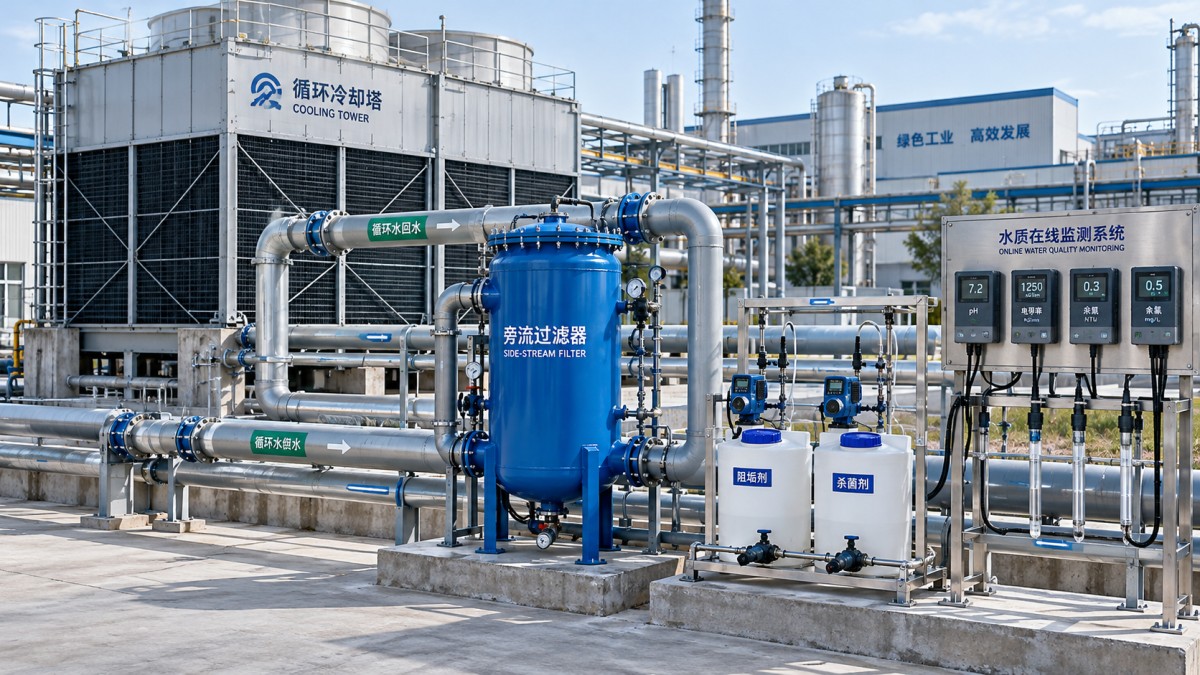
Side-stream filtration can reduce deposits and improve the conditions for biological control, but it cannot replace dissolved-solids management. Softening removes calcium and magnesium hardness but does not broadly desalinate the water. Reverse osmosis can improve makeup quality substantially, yet it creates a reject stream and changes the chemistry that the corrosion-control program must manage.
Ask for the proposed filter flow and particle-removal performance to be justified against the contamination load and system hydraulics. A nominal filtration rating means little if the equipment processes too little water or leaves sediment collecting in poorly circulated areas.

For chemical treatment, require the supplier to explain the operating range and interaction of the proposed chemicals. Acid dosing, for example, can reduce carbonate scaling potential, but its control and material implications must be evaluated. Naming a chemical without specifying dosing safeguards and monitoring leaves a major part of the design unresolved.
Give microbial control its own operating requirements
Cooling towers can release aerosols, so biological control must address both equipment cleanliness and health risks, including Legionella. Include a site-specific water management program with assigned responsibilities, monitoring locations, operating limits, corrective actions, and records. A chemical supply contract alone does not provide that program.
Require the proposed biocide strategy to account for pH, temperature, contamination load, system volume, and circulation. Oxidizing disinfectants can be useful, but their effectiveness depends on water conditions and disinfectant demand. Supplemental non-oxidizing treatment may be appropriate where justified by the system and biological conditions.
Do not accept a universal dosing schedule without an explanation of how it maintains effective treatment throughout the circuit. Dead legs, standby equipment, low-flow branches, and intermittent operation can leave areas inadequately treated even when the basin measurement appears acceptable.
Define cleaning, inspection, startup, and shutdown procedures alongside chemical control. Disinfectant measurements and microbial tests provide different information; neither alone demonstrates that every wetted surface is free of biofilm. The specification should state how results lead to investigation, cleaning, or treatment changes.
Specify controls that support reliable operation
Monitoring should lead to an operating decision. At minimum, consider makeup and blowdown flow measurement, conductivity-based blowdown control, dosing-system status, and accessible sampling points. Add pH, disinfectant residual, corrosion monitoring, or other measurements where the treatment strategy requires them.
Define sensor placement, calibration, cleaning, alarm thresholds, and the response expected after an alarm. A sensor in a stagnant sample line can produce a convincing but unrepresentative reading. Online measurements should be checked against appropriate manual or laboratory methods.
Controls also need to handle failures. State what happens if circulation stops, the sample flow fails, a chemical tank empties, or the blowdown valve remains open. Chemical dosing interlocks should follow the process hazard assessment and prevent dosing under unsuitable flow or operating conditions.
Remote dashboards can help track trends and exceptions, especially across several towers. Their value depends on measurement quality and clear ownership of the response. Specify data retention, export capability, and access rights so operating history remains available when service providers change.
Evaluate reclaimed water and discharge as connected decisions
Reclaimed water may reduce freshwater demand, but its suitability depends on its quality and variability. Organics, nutrients, ammonia, salts, and suspended solids can change disinfectant demand, corrosion behavior, fouling potential, and achievable cycles. Specify the quality envelope at the cooling-system inlet, including conditions for blending, additional treatment, or temporary diversion.
Assess blowdown using the proposed circulating-water chemistry and chemical program. Increasing cycles reduces blowdown volume while increasing many constituent concentrations. That may affect wastewater treatment, reuse options, and discharge compliance. A lower discharge volume does not automatically produce an easier waste stream to manage.
Where zero liquid discharge is a project requirement, evaluate cooling-tower blowdown within the whole-site water balance. Include treatment reject streams, regeneration waste, filter backwash, and cleaning waste. Removing salts from makeup water transfers them into another stream that still needs a defined destination.
This system-level approach fits the water-reuse and infrastructure benchmarking scope of G-WIC: compare complete treatment arrangements by their resource demands, residual streams, operating requirements, and measurable performance. Component specifications are useful only when their combined effect on the facility is understood.
Make supplier commitments measurable and comparable
A usable specification separates equipment supply, treatment performance, and service responsibilities. It should define who provides sampling, chemicals, calibration, cleaning, laboratory analysis, operator training, and emergency support. Ambiguous scope can leave essential tasks unassigned after commissioning.
Ask each supplier to submit the same core deliverables:
- A design basis showing source-water assumptions, operating conditions, proposed cycles, and limiting risks.
- A process description and water balance covering normal operation, startup, shutdown, and relevant upset conditions.
- A treatment-control plan with operating ranges, sampling methods, alarms, and corrective actions.
- Expected consumption of water, chemicals, energy, and consumables, with the calculation basis stated.
- An acceptance plan linking performance criteria to measurement methods, test conditions, duration, and responsibility.
Acceptance criteria should include more than clean-looking basin water. Depending on the system, they may cover corrosion measurements, deposit assessment, biological-control performance, control reliability, and normalized heat-exchanger performance. Establish the method and baseline before the trial begins. Corrosion coupons, for example, need defined materials, exposure conditions, and evaluation procedures to make results meaningful.
Separate initial commissioning from sustained performance verification. Commissioning proves that equipment, dosing, sensors, and interlocks operate correctly. A subsequent operating period evaluates treatment under representative loads and water conditions. State how deviations outside the agreed design envelope affect the assessment.
Compare lifecycle cost on a common basis: water supply, blowdown handling, chemicals, electricity, maintenance labor, consumables, and treatment-related cleaning. A low chemical price may be offset by higher water use or greater maintenance demand.
Before releasing the specification, require a clear answer to three questions: what condition limits the treatment strategy, how will operators detect movement toward that limit, and what action follows? Those answers turn a collection of products into an operating plan that can be reviewed, commissioned, and maintained.
Recommended News
TIME
{item.publish_time}{item.title}{item.description}auth.
{item.goods_category_sif3qfva9d}Read MoreCONTACT US