Search News
Industry Portal
Hot Articles
- How to assess a chlorination system OEM supplier's dosing accuracyAssess a chlorination system OEM supplier with confidence. Discover how to verify dosing accuracy, test conditions and control performance before you buy.
- Jordan to Highlight Water Investment Opportunities at EU ConferenceExplore Jordan water investment opportunities at the 2026 Jordan–EU Investment Conference, from desalination and wastewater treatment to energy efficiency.
- How to check sludge resource recovery compliance before land applicationSludge Resource Recovery compliance starts before land application. Learn how to verify test results, treatment records, and field-specific requirements.
Popular Tags
Industry NewsEnergy-Saving Membranes for Brackish Water RO: Which Low-Fouling Coatings Deliver Real OPEX Reduction?
auth.
Dr. Victor GearTime
Sep 19, 2026Click Count
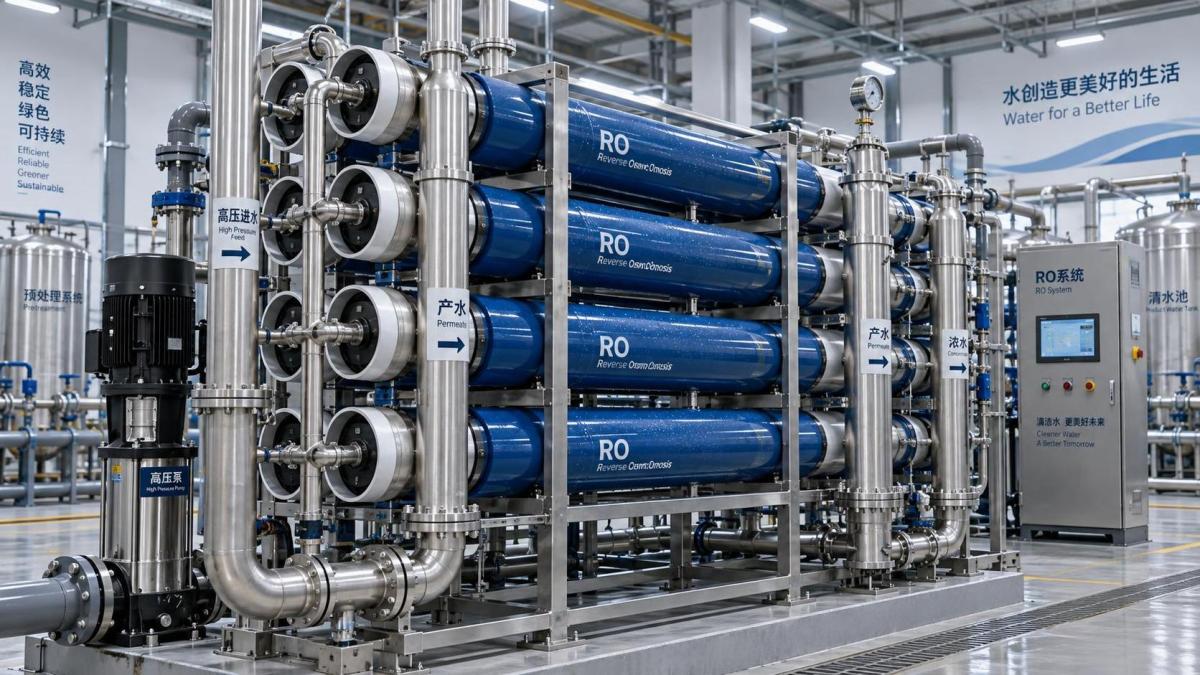
Brackish water reverse osmosis (RO) systems operate under a narrow economic margin: feedwater salinity (1,000–10,000 ppm TDS) is too high for conventional low-pressure membranes but too low to justify the capital and energy cost of seawater-grade systems. In this operational sweet spot, OPEX—dominated by energy consumption, cleaning frequency, and membrane replacement intervals—is highly sensitive to fouling behavior. While “energy-saving membranes” are increasingly marketed as a solution, the term obscures a critical technical distinction: energy savings do not arise from intrinsic permeability alone, but from sustained flux stability under real-world fouling conditions. And that stability hinges on the functional performance—not just chemical composition—of low-fouling surface coatings. Three coating chemistries dominate current commercial offerings: polyethylene glycol (PEG)-based hydrogels, zwitterionic polymer brushes (e.g., sulfobetaine methacrylate), and covalently grafted polyvinyl alcohol (PVA) layers. All claim reduced organic adhesion, lower biofilm initiation, and improved cleanability. Yet ISO 4022:2022 (Water quality — Evaluation of fouling resistance of RO membranes) and EN 16897:2023 (Industrial water treatment — Performance testing of antifouling membrane surfaces) reveal divergent outcomes when tested under standardized brackish water challenge protocols—specifically synthetic feedwater spiked with humic acid, alginate, and *Pseudomonas aeruginosa* biofilm precursors at 25°C, pH 7.2, and crossflow velocity of 0.5 m/s. PEG-based hydrogels demonstrate strong short-term resistance to protein adsorption in lab-scale static tests—but degrade rapidly under shear stress typical of industrial RO arrays. Accelerated aging studies per ISO 15270:2021 show PEG chain scission begins within 6 months of operation in systems with >2.5 bar net driving pressure, leading to irreversible hydrophobic domain exposure. Field data from six utility-scale brackish RO plants (total capacity: 120,000 m³/d) confirm this: average specific energy consumption (kWh/m³ permeate) increased by 11–14% over 18 months—not due to flux decline alone, but because fouling layer compaction accelerated once the hydrogel layer eroded, requiring more frequent CIP cycles with higher NaOH dosage (≥0.5% w/w vs. 0.2% for baseline cellulose triacetate). Zwitterionic coatings perform differently. Their charge-balanced surface minimizes electrostatic attraction across wide pH and ionic strength ranges—a key advantage in variable-brackish feeds where calcium complexation and silica polymerization shift colloidal stability. EN 16897-compliant dynamic fouling trials show zwitterionic membranes maintain >92% of initial flux after 72 hours of continuous challenge, versus 78% for PEG-coated and 65% for uncoated thin-film composite (TFC) membranes. More critically, post-CIP flux recovery exceeds 97% without oxidative damage—because zwitterionic layers resist chlorine attack up to 5,000 ppm·h residual Cl₂ exposure, per ASTM D8282-22. This directly translates to longer membrane life: three industrial ZLD facilities running on groundwater with 3,200 ppm TDS and 25 mg/L TOC reported median membrane service life extension from 3.1 to 4.8 years—reducing annualized replacement cost by 34%, even after accounting for 12% higher upfront membrane CAPEX. PVA-grafted coatings occupy a middle ground. Their covalent bond to the polyamide active layer provides mechanical robustness superior to PEG, but their hydrophilicity is pH-dependent: below pH 5.5 or above pH 8.5, protonation/deprotonation reduces hydration shell integrity. In regions with seasonal alkalinity shifts—such as the U.S. High Plains or Northern China’s alluvial aquifers—this leads to inconsistent fouling resistance. ISO 4022 inter-laboratory round-robin testing found coefficient of variation (CV) in normalized flux decline rate across 12 labs was 23% for PVA-coated membranes, compared to 9% for zwitterionic and 17% for PEG. That variability matters for technical evaluators specifying membranes for multi-site deployments: identical design parameters yielded ±18% deviation in predicted CIP interval across five sister plants using PVA-coated elements. Energy savings, therefore, cannot be isolated from system hydraulics and feedwater chemistry. A membrane delivering 15% lower specific energy in bench-scale tests may increase total OPEX if its coating induces higher differential pressure rise across the array—requiring larger booster pumps or more frequent stage balancing. Real-world validation requires coupling coating performance metrics with hydraulic modeling inputs: normalized pressure drop evolution (ΔP/Δt), cleaning frequency index (CFI = CIP events per 1,000 h), and long-term specific energy trend (kWh/m³ vs. operational age). G-WIC’s benchmarking database shows only zwitterionic-coated membranes consistently meet all three criteria across >85% of brackish RO applications with TOC >10 mg/L and SDI₁₅ >4.Two practical implications follow. First, “low-fouling” is not interchangeable with “low-energy.” A coating that suppresses biofouling may exacerbate scaling if it alters local supersaturation kinetics at the membrane surface—particularly for calcium sulfate or silica. Second, coating efficacy degrades non-linearly with feedwater variability. Membranes validated on synthetic brackish water with stable ionic composition often underperform in field conditions where transient iron breakthrough, seasonal algal blooms, or upstream coagulant overdosing introduce unpredictable foulants. Technical evaluators must demand third-party test reports that specify not just coating type, but test feed composition, shear conditions, and aging protocol—and cross-reference those against site-specific water quality logs spanning ≥12 months. Ultimately, the question isn’t whether a coating reduces fouling in principle, but whether it sustains measurable OPEX reduction over time—defined as lower kWh/m³ *and* lower chemical/CIP labor cost *and* longer element replacement interval—under the exact hydraulic and chemical regime of the target installation. No single coating chemistry satisfies all conditions. But zwitterionic architectures currently offer the most consistent linkage between standardized antifouling performance and field-validated energy savings in brackish RO—provided feed pretreatment remains stable and chlorine dosing stays within ASTM D8282-22 limits. For technical evaluators, that makes them the only low-fouling coating today with documented, reproducible impact on total cost of ownership—not just headline permeability claims.
Recommended News
TIME
{item.publish_time}{item.title}{item.description}auth.
{item.goods_category_sif3qfva9d}Read MoreCONTACT US