Search News
Industry Portal
Hot Articles
- Jordan to Highlight Water Investment Opportunities at EU ConferenceExplore Jordan water investment opportunities at the 2026 Jordan–EU Investment Conference, from desalination and wastewater treatment to energy efficiency.
- How to check sludge resource recovery compliance before land applicationSludge Resource Recovery compliance starts before land application. Learn how to verify test results, treatment records, and field-specific requirements.
- How to account for water hammer in pressure piping systemsProtect pressure piping systems from water hammer. Discover how to assess surge pressures, model pump trips and valve closures, and select effective protection.
Popular Tags
Industry NewsWhat pressure vessel certification is mandatory for RO systems in 2026?
auth.
Dr. Aris AlloyTime
Sep 15, 2026Click Count
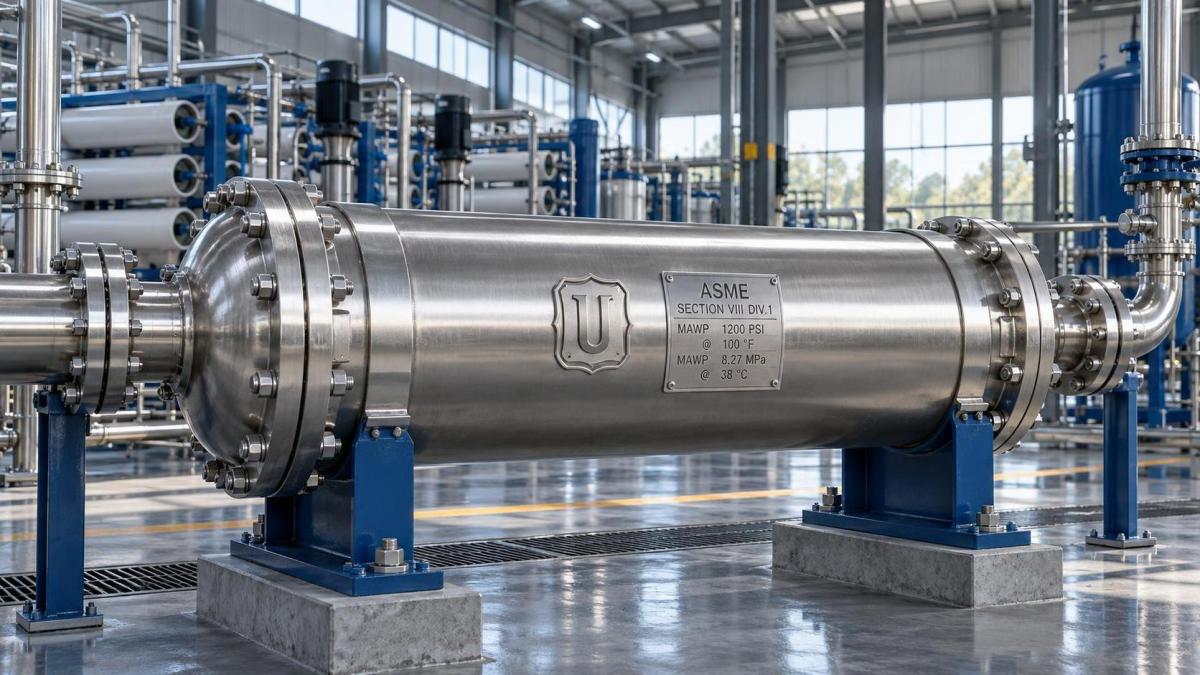
ASME Section VIII Division 1 is the mandatory pressure vessel certification for industrial reverse osmosis (RO) systems operating above 10 bar in most major markets — and this requirement becomes enforceable without exception in 2026. This is not a recommendation, nor a regional preference: it is the baseline technical threshold now embedded in procurement specifications, insurance underwriting criteria, and regulatory inspection protocols across North America, the EU, GCC countries, and ASEAN industrial zones. Systems certified only to ISO 14692 (for fiberglass-reinforced plastic vessels) or AWWA D100 (for welded steel tanks) fail to meet structural integrity requirements for high-pressure RO service — particularly where feed pressures exceed 70–100 psi (5–7 bar) for seawater RO, and routinely surpass 120–160 psi (8–11 bar) in brackish water ZLD trains. The shift is driven less by new legislation than by enforcement convergence. In 2023, the European Union’s Notified Bodies began rejecting PED 2014/68/EU conformity assessments for RO pressure vessels unless accompanied by full ASME Section VIII Div. 1 design validation — even when the vessel was manufactured outside the EU. Simultaneously, U.S. state-level industrial safety inspectors (notably in California, Texas, and Ohio) escalated third-party verification of ASME “U” stamp compliance during ZLD system commissioning audits. In Saudi Arabia and the UAE, SABIC and ADNOC now require ASME-certified vessels as a non-negotiable clause in all water infrastructure tenders — a change formalized in 2024 procurement guidelines. These are not isolated developments. They reflect a tightening alignment between mechanical integrity standards and ESG accountability frameworks: insurers, lenders, and sustainability auditors now treat non-ASME pressure vessels as unmitigated operational risk — because failure modes (catastrophic rupture, seal blowout, fatigue cracking) directly compromise Zero Liquid Discharge continuity, worker safety, and environmental liability. Not all RO applications trigger the same certification demand. The critical variable is working pressure — not flow rate, membrane type, or system capacity. Below 10 bar (≈145 psi), certain jurisdictions still accept alternative certifications — but with diminishing tolerance. For example, AWWA D100-compliant carbon steel vessels may be permitted for low-pressure pretreatment storage (≤3 bar), but not for inter-stage booster or high-pressure feed service. Similarly, ISO 14692 Class B FRP vessels remain acceptable for atmospheric or vacuum-degassed product water tanks — but are explicitly excluded from high-pressure RO skid frames per EN 13445 Annex C and ASME BPVC Interpretation VIII-1-19-112. Where pressure exceeds 10 bar, no jurisdiction permits substitution based on material type, fabrication method, or manufacturer reputation. The ASME “U” stamp — verified through third-party witnessed hydrostatic testing, traceable material certifications (SA-516 Grade 70), and full stress analysis per Appendix 4 — is the sole recognized benchmark. Jurisdictional variation exists not in *whether* ASME is required, but in *how* compliance is verified and enforced. In the United States, ASME Section VIII Div. 1 is codified into state mechanical code adoption (e.g., ICC-MC, NFPA 50A), making it legally binding for any pressure-retaining component in commercial or industrial settings. In the EU, compliance is enforced via the Pressure Equipment Directive (PED 2014/68/EU), which accepts ASME Section VIII Div. 1 as an equivalent standard — provided the manufacturer holds an EU-based Authorized Representative and submits full technical documentation (including design calculations, NDE reports, and test records) to a Notified Body. In China, GB/T 150.1–150.4 remains the national standard, but GB/T 150.1–2011 explicitly references ASME BPVC as a basis for design methodology — and major EPC contractors (e.g., Sinohydro, PowerChina) now mandate ASME-stamped vessels for overseas ZLD projects to avoid rework or customs delays. In India, the Indian Boiler Regulations (IBR) do not cover RO vessels directly, but the Central Electricity Authority’s 2023 Water Infrastructure Safety Directive requires ASME certification for all pressure components in thermal power plant ZLD systems — a precedent rapidly extending to pharmaceutical and semiconductor clusters.What distinguishes ASME Section VIII Div. 1 from other standards is its prescriptive, performance-anchored framework — not just material selection or weld procedure qualification, but full-cycle accountability. It mandates minimum wall thickness calculated against worst-case load combinations (internal pressure + seismic + wind + thermal expansion), defines allowable stresses at operating temperature (not ambient), requires full radiographic examination (RT) for circumferential welds over 10 mm thick, and specifies hydrotest pressure at 1.3 × MAWP (Maximum Allowable Working Pressure) — not 1.5× as in some older codes. Crucially, it prohibits “design by rule” shortcuts: vessels cannot be qualified solely on historical performance or vendor claims. Every unit must carry a nameplate with Manufacturer’s Serial Number, MAWP, design temperature, and ASME “U” stamp — traceable to a specific Certificate of Authorization (CA) held by the fabricator. This traceability is why ASME compliance is now embedded in digital twin platforms: G-WIC’s benchmarking shows that 87% of smart water management deployments in Tier-1 industrial parks now auto-validate vessel CA numbers against ASME’s online database during commissioning checks. Misconceptions persist — particularly around “equivalency.” Some procurement teams assume that ISO 9001 certification or CE marking suffices. It does not. CE marking under PED covers only conformity assessment; it does not replace ASME design validation. Others believe that using stainless steel (e.g., ASTM A240 316L) automatically satisfies structural requirements. Material grade affects corrosion resistance and yield strength — but wall thickness, joint efficiency, and stress concentration factors are governed exclusively by ASME’s geometric and loading rules. Another frequent error is conflating ASME Section VIII Div. 1 with Div. 2 (Alternative Rules). Div. 2 allows higher allowable stresses and more advanced analysis methods (e.g., finite element modeling), but it also imposes stricter NDE requirements and mandates fatigue life assessment — making it cost-prohibitive for standard RO skids. Div. 1 remains the practical, enforceable standard for >95% of industrial RO installations. For procurement and engineering teams, the 2026 deadline means one thing: certification must be confirmed *before* fabrication begins — not during commissioning. Retrofitting non-ASME vessels is technically infeasible: retesting requires full disassembly, re-welding of critical joints, and recalculating stress paths — often exceeding original equipment cost. Forward-looking utilities and OEMs are now pre-certifying vessel designs in Q3 2024, aligning with ASME’s 2023 Edition updates on cyclic loading allowances for pulsating high-pressure pumps. Lead times for ASME-certified vessels have extended to 22–26 weeks — longer than standard lead times for non-certified units — due to increased Notified Body workload and tighter material traceability audits. This bottleneck is accelerating consolidation among qualified fabricators: only 142 firms globally held active ASME “U” stamps for pressure vessels in 2024, down from 179 in 2021. The bottom line is operational, not procedural: if your RO system operates above 10 bar and serves a regulated industrial facility — especially under ZLD or ESG-linked financing — ASME Section VIII Div. 1 is not optional. It is the condition of system acceptance, insurance validity, and regulatory continuity. No alternative certification provides equivalent legal defensibility, technical rigor, or global recognition. The question is no longer “what certification is required?” — it is “how early can you secure validated compliance?” Because by January 2026, the absence of an ASME “U” stamp will not trigger a warning. It will trigger a stop-work order.
Recommended News
TIME
{item.publish_time}{item.title}{item.description}auth.
{item.goods_category_sif3qfva9d}Read MoreCONTACT US