Search News
Industry Portal
Hot Articles
- Seawater Desalination System Factory Selection: 7 Mistakes That Delay CommissioningSeawater desalination system factory selection can make or break commissioning. Discover 7 costly mistakes, key checklist points, and smarter ways to compare suppliers.
- Dissolved Air Flotation (DAF) Wholesale: What to Check Beyond the Quoted PriceDissolved air flotation (DAF) wholesale is about more than price. Learn how to compare performance, materials, sludge handling, compliance, and service to avoid hidden costs.
- Choosing a Chlorination System OEM Supplier Without Creating Maintenance HeadachesChlorination system OEM supplier selection affects uptime, spares, and service costs. Learn how to avoid maintenance headaches with a practical, lifecycle-focused evaluation guide.
Popular Tags
Industry NewsHow to Compare Industrial Wastewater Treatment Suppliers Fairly
auth.
Dr. Elena HydroTime
Apr 23, 2026Click Count
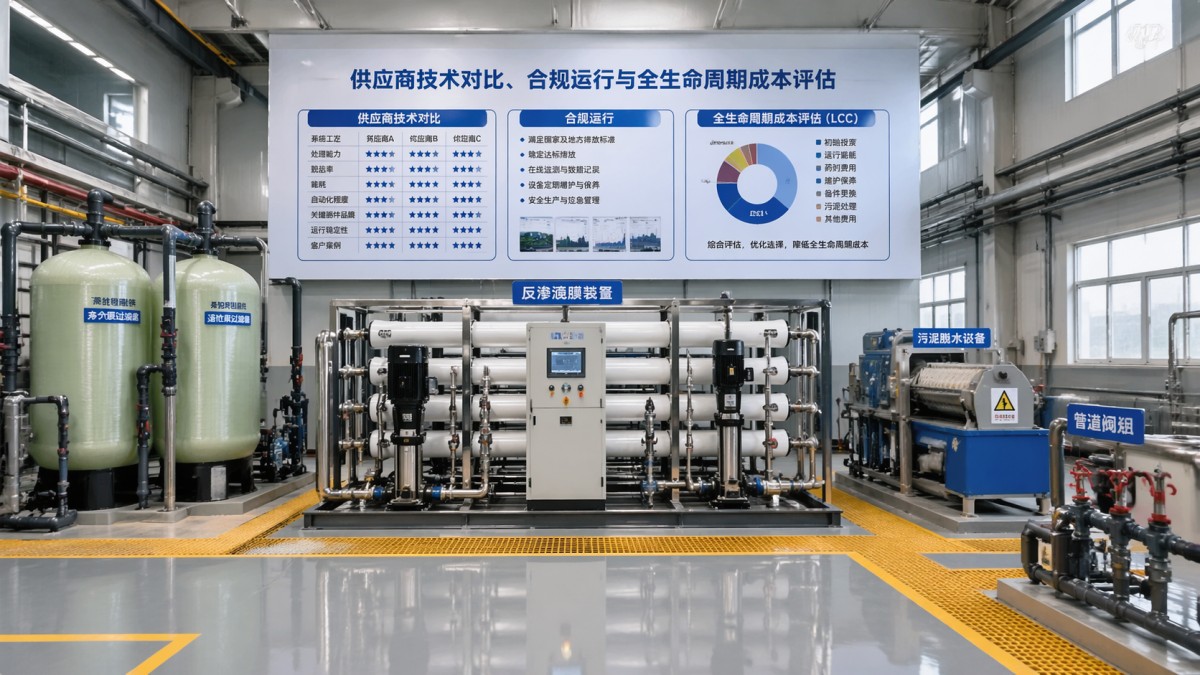
Choosing an industrial wastewater treatment supplier fairly means comparing far more than price. The right decision depends on whether a supplier can meet your discharge targets, support stable operations, comply with regulations, and deliver lifecycle value through reliable treatment, reuse, and sludge handling performance. For most buyers, the fairest comparison method is to use a weighted scorecard that evaluates technical fit, compliance, operating cost, service capability, and project risk side by side.
This matters because two suppliers can offer similar quotations while delivering very different long-term results. Differences in reverse osmosis membrane quality, pretreatment design, sludge treatment equipment, automation, chemical consumption, energy demand, and after-sales support can significantly change total cost of ownership. A fair comparison framework helps procurement teams, engineers, operators, and decision-makers avoid biased selection and choose an advanced water treatment solution that performs in real operating conditions.
What should you compare first when evaluating industrial wastewater treatment suppliers?

Start with fitness for purpose, not price. The first question is simple: can this supplier treat your wastewater reliably under your operating conditions? Industrial wastewater varies widely by sector, flow pattern, contaminant load, salinity, pH, temperature, and regulatory endpoint. A supplier that performs well for food processing effluent may not be suitable for electronics, textile dyeing, metal finishing, pharmaceuticals, or landfill leachate.
Before comparing offers, define a common basis for evaluation:
- Influent characteristics: COD, BOD, TSS, TDS, ammonia, oil and grease, heavy metals, silica, hardness, pH, temperature, peak loads, and seasonal variation
- Target outcomes: discharge compliance, water reuse, zero liquid discharge, resource recovery, or sludge minimization
- Operating constraints: footprint, utilities, labor availability, automation level, uptime requirements, and future expansion
- Commercial assumptions: capex, opex, membrane replacement intervals, chemical cost, spare parts, and service response time
If suppliers are not quoting against the same design basis, the comparison will not be fair. One may size conservatively for performance stability, while another may underdesign to appear cheaper. Require every bidder to respond to the same influent data, effluent guarantee, recovery target, and operating hours.
How can buyers compare suppliers fairly instead of choosing the lowest quote?
The fairest approach is to use a weighted evaluation matrix. This prevents low upfront pricing from overshadowing technical risk, compliance exposure, or long-term operating cost. For industrial wastewater treatment, a practical scorecard often includes the following categories:
- Technical performance: process suitability, guaranteed effluent quality, recovery rate, resilience to influent fluctuation
- Regulatory standards compliance: local discharge rules, reuse standards, safety requirements, documentation quality, validation record
- Total cost of ownership: energy, chemicals, membrane replacement, sludge disposal, maintenance labor, downtime risk
- Equipment quality: reverse osmosis membrane specifications, pumps, instrumentation, control system, corrosion resistance, skid fabrication quality
- Service and execution: commissioning support, operator training, remote monitoring, spare parts availability, local service capability
- Supplier credibility: reference projects, technical depth, financial stability, warranty terms, transparency of assumptions
A weighted scoring model does not need to be complex. For example, many industrial buyers assign 30% to technical fit, 25% to lifecycle cost, 20% to compliance and risk, 15% to service capability, and 10% to supplier references and project delivery confidence. The exact weights should reflect your business priorities. A plant under strict discharge pressure may prioritize compliance and reliability. A high-water-cost facility may emphasize reuse rate and operating efficiency.
Most importantly, score evidence, not sales claims. Ask each supplier to support stated performance with pilot data, reference installations, membrane design calculations, sludge yield estimates, and consumable assumptions.
Which technical details make the biggest difference in long-term performance?
Many buyers focus on broad process labels such as “MBR,” “RO,” “evaporation,” or “sludge dewatering,” but the outcome is often determined by details inside the design. This is where fair supplier comparison becomes especially important.
1. Pretreatment design
A strong downstream system can still fail if pretreatment is weak. Compare equalization strategy, screening, oil separation, pH control, coagulation-flocculation, biological stability, and solids removal. Poor pretreatment can shorten membrane life, increase cleaning frequency, and destabilize sludge handling.2. Reverse osmosis membrane specifications
Do not compare RO systems by membrane count alone. Review membrane brand, salt rejection, fouling tolerance, cleaning limits, flux assumptions, recovery design, pressure vessel arrangement, and expected replacement cycle. Ask whether the design includes realistic protection against scaling, biofouling, and organics loading. A lower-cost membrane package can become far more expensive if cleaning frequency and replacement rates rise quickly.3. Sludge treatment equipment
Sludge is often underestimated in wastewater project budgeting. Compare sludge thickening, dewatering technology, polymer consumption, final cake dryness, odor control, and disposal or valorization pathways. Better sludge treatment equipment can reduce hauling cost, improve safety, and support circular economy in wastewater treatment strategies.4. Automation and controls
A system that relies heavily on manual intervention may be difficult to run consistently, especially in facilities with limited operator availability. Evaluate PLC logic, alarms, remote access, data logging, dosing automation, and integration with plant SCADA or digital monitoring platforms.5. Materials of construction
Skid quality, coatings, stainless grade, FRP quality, piping compatibility, and corrosion resistance affect durability. This is especially relevant for high chloride streams, acidic or alkaline wastewater, and thermal processes.When comparing advanced water treatment systems, the best supplier is not always the one with the most complex flowsheet. It is usually the one whose technical design is most robust, maintainable, and suited to your real influent variability.
How do you compare industrial wastewater treatment cost accurately?
A fair cost comparison requires separating purchase price from actual lifecycle cost. Many procurement errors happen because buyers compare capex only, while the true economic impact appears over years of operation.
Key cost elements to compare include:
- Power consumption per cubic meter treated
- Chemical consumption and dosing sensitivity
- Membrane replacement frequency and cleaning chemicals
- Sludge generation, dewatering, transport, and disposal cost
- Labor requirement and operator skill dependency
- Maintenance intervals and spare parts pricing
- Downtime exposure and production risk
- Water recovery and reuse savings
Request each supplier to provide a five-year or ten-year operating cost model based on the same assumptions: feedwater quality, runtime, energy tariff, chemical pricing, disposal charges, and water value. This helps you compare industrial wastewater treatment cost on a normalized basis.
Also look closely at what is excluded. Civil works, tanks, odor control, CIP systems, instrumentation, commissioning, and operator training are sometimes omitted from low initial quotations. A cheaper proposal can become more expensive after scope gaps are filled.
For facilities pursuing industrial wastewater recycling systems, include the value of recovered water in the comparison. Higher recovery may justify higher capex if freshwater tariffs are rising or if water availability is a strategic risk to production continuity.
How should compliance, safety, and risk be assessed?
Regulatory and operational risk should be treated as core evaluation criteria, not secondary paperwork. If a supplier cannot demonstrate compliance confidence, the “best price” may expose the buyer to fines, shutdowns, environmental incidents, or reputation damage.
Assess suppliers on these questions:
- Do they provide clear effluent guarantees tied to your permit requirements?
- Can they document alignment with relevant regulatory standards, safety rules, and engineering codes?
- How do they handle upset conditions, peak loads, toxic shocks, or utility interruptions?
- What redundancy is included for critical components such as pumps, blowers, dosing systems, and control instruments?
- What commissioning and performance validation procedure do they follow?
- How are sludge, concentrates, or hazardous byproducts managed?
For quality managers and safety professionals, supplier transparency is a strong indicator of reliability. Serious providers are usually willing to share P&IDs, equipment lists, design assumptions, HAZOP-related considerations, and acceptance test methodology. If a bidder avoids details or relies only on generic brochures, that is a warning sign.
What questions should you ask suppliers before making a final decision?
A strong supplier comparison process includes direct technical and commercial questioning. The goal is not to challenge vendors unfairly, but to reveal differences that quotations alone cannot show.
Useful questions include:
- Which similar projects have you delivered with comparable wastewater characteristics?
- What influent variability can your design tolerate without violating discharge limits?
- Which reverse osmosis membrane specifications and cleaning strategy are you proposing, and why?
- How much sludge will the system generate, and what sludge treatment equipment is included?
- What assumptions drive your opex model?
- What is excluded from your scope?
- What local service support, spare parts stock, and operator training do you provide?
- How will you prove performance during commissioning and acceptance testing?
- What are the most likely failure modes in this design, and how are they mitigated?
These questions help decision-makers compare suppliers more objectively while giving operators and project managers better visibility into day-to-day practicality.
What does a fair final decision look like?
A fair decision is transparent, evidence-based, and aligned with plant priorities. It should not automatically favor the lowest bid, the most recognizable brand, or the most aggressive sales promise. Instead, it should select the supplier that offers the best combination of process fit, compliance confidence, lifecycle economics, operability, and long-term support.
In practice, that means:
- Using a common technical basis for all bids
- Scoring suppliers with weighted criteria
- Comparing total cost of ownership, not just capex
- Verifying claims through references, pilot data, and documentation
- Evaluating reuse, sludge, and circularity outcomes alongside treatment performance
For organizations investing in advanced water treatment, the fairest supplier comparison process is also the most strategic one. It protects operational continuity, supports ESG and circular economy goals, and reduces the chance of choosing a system that looks good on paper but underperforms in the field.
Ultimately, if you want to compare industrial wastewater treatment suppliers fairly, compare evidence, assumptions, and lifecycle impact—not just equipment labels or quote totals. That approach leads to better technical outcomes, better financial decisions, and more resilient wastewater infrastructure.
- Water Infrastructure
- Circular Economy
- Zero Liquid Discharge
- Water Treatment
- Industrial Wastewater
- Sludge Treatment
- Reverse Osmosis
- Water Tariffs
- Regulatory Standards
- Reverse Osmosis membrane specifications
- Circular Economy in wastewater treatment
- Industrial Wastewater treatment supplier
- Industrial Wastewater recycling systems
- Sludge Treatment equipment
- Industrial Wastewater treatment cost
- Regulatory Standards compliance
Recommended News