Search News
Industry Portal
Hot Articles
- Seawater Desalination System Factory Selection: 7 Mistakes That Delay CommissioningSeawater desalination system factory selection can make or break commissioning. Discover 7 costly mistakes, key checklist points, and smarter ways to compare suppliers.
- Dissolved Air Flotation (DAF) Wholesale: What to Check Beyond the Quoted PriceDissolved air flotation (DAF) wholesale is about more than price. Learn how to compare performance, materials, sludge handling, compliance, and service to avoid hidden costs.
- Choosing a Chlorination System OEM Supplier Without Creating Maintenance HeadachesChlorination system OEM supplier selection affects uptime, spares, and service costs. Learn how to avoid maintenance headaches with a practical, lifecycle-focused evaluation guide.
Popular Tags
Industry NewsWhy Industrial Wastewater Treatment Costs Vary So Much
auth.
Dr. Elena HydroTime
Apr 23, 2026Click Count
Industrial Wastewater treatment cost can differ dramatically from one project to another because influent quality, plant scale, Regulatory Standards compliance, and technology selection all reshape capital and operating expenses. From Reverse Osmosis membrane specifications to Sludge Treatment equipment and Industrial Wastewater recycling systems, every design choice affects long-term value. This guide explains the real cost drivers behind Advanced Water Treatment solutions and smarter Circular Economy in wastewater treatment strategies.
For researchers, plant operators, project managers, safety teams, distributors, and corporate decision-makers, the question is rarely “What is the price of wastewater treatment?” The more useful question is “Which technical and regulatory variables are driving this price, and which costs can be optimized without creating compliance or reliability risk?” In B2B water infrastructure projects, the difference between a basic equalization-plus-biological line and a high-recovery reuse or ZLD configuration can shift lifecycle spending by several multiples.
That is why serious evaluation requires more than vendor quotations. It requires a system-level view of influent chemistry, hydraulic variation, sludge generation, discharge targets, automation level, energy demand, maintenance frequency, and long-term water reuse value. For organizations navigating ESG targets, tightening discharge permits, and volatile water tariffs, understanding these cost drivers is essential for better capital planning and procurement decisions.
What Actually Makes Industrial Wastewater Treatment So Expensive or Affordable

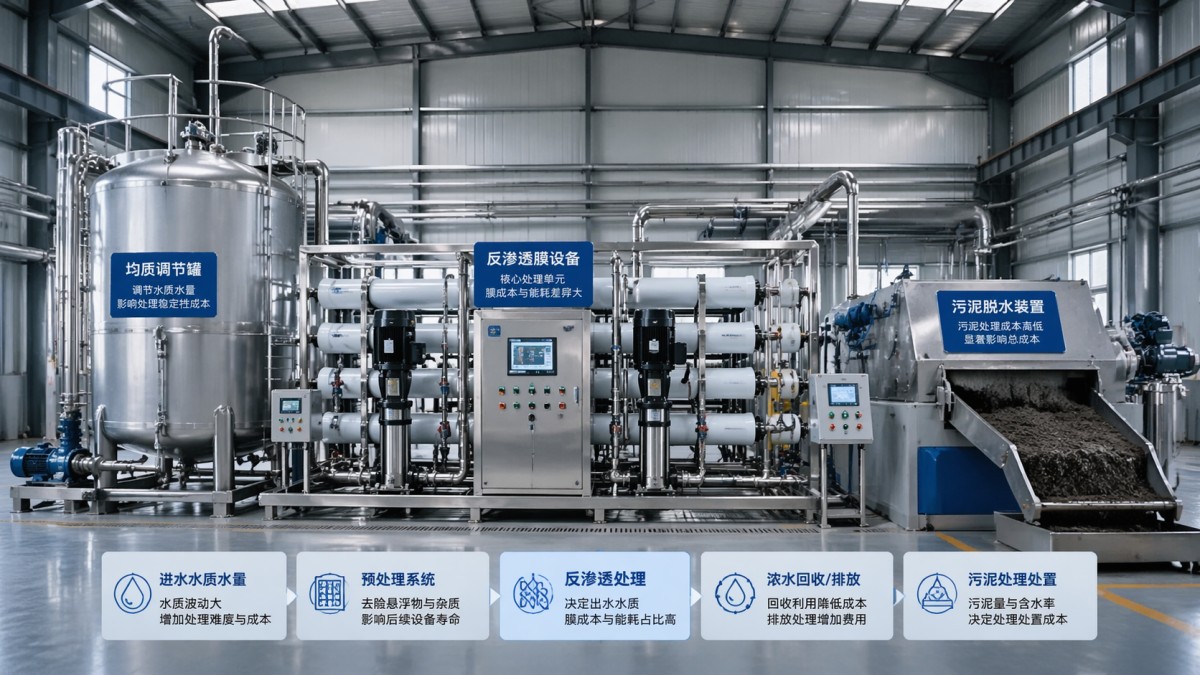
Industrial wastewater treatment cost is built from two major categories: capital expenditure and operating expenditure. Capital expenditure includes civil works, tanks, piping, pumps, instrumentation, automation, electrical systems, and core process equipment. Operating expenditure includes energy, chemicals, membrane replacement, labor, sludge disposal, maintenance parts, and compliance monitoring. A low-CAPEX plant can become a high-OPEX burden within 12–24 months if the design does not match the real wastewater profile.
Influent quality is usually the first cost multiplier. A facility treating wastewater with COD below 1,500 mg/L and low salinity may use a simpler biological route. By contrast, wastewater containing heavy metals, solvents, oils, color, surfactants, silica, or TDS above 10,000 mg/L often requires multi-stage treatment. That may include chemical pretreatment, DAF, UF, RO, evaporation, crystallization, or advanced oxidation. Each added barrier raises not only equipment cost but also control complexity and spare parts demand.
Flow variability matters almost as much as average flow. A plant rated for 500 m³/day with stable loading is more economical to run than one handling 300 m³/day on average but fluctuating between 80 and 700 m³/day. Large peaks require buffer tanks, stronger pumps, oversized blowers, or smarter automation logic. If shock loads are frequent, the cost of process instability, off-spec discharge, and emergency chemical dosing can be significant.
Treatment target also changes the economics. Meeting a standard discharge limit is not the same as producing reuse water for cooling towers, boilers, process washing, or ultrapure feed. As recovery rises from 50% to 75% and then toward 90%+, costs usually increase nonlinearly because concentrate management becomes harder. This is especially true in water-scarce industrial parks where reuse requirements are strict and ZLD is being adopted.
Core Cost Drivers at a Glance
The table below summarizes the main variables that change industrial wastewater treatment cost from project to project. It is useful during early-stage budgeting, technology screening, and tender preparation.
The practical lesson is simple: the lowest installed price is not automatically the lowest project cost. In many industrial sectors, 5–10 years of operating cost will exceed the initial equipment investment, especially when water reuse, membranes, or thermal concentration are involved.
How Industry Type and Wastewater Chemistry Change the Design Basis
Different industries produce wastewater with very different treatment challenges. Food and beverage plants often deal with high biodegradable loads, fats, oils, grease, and washdown peaks. Electroplating and metal finishing introduce chromium, nickel, zinc, cyanide, and acidic or alkaline streams. Textile, dyeing, and chemical facilities may have strong color, refractory COD, surfactants, and salinity. Semiconductor and pharmaceutical operations can require tighter water recovery control and trace contaminant management.
Because of these differences, technology pathways cannot be standardized too aggressively. A biological system may be ideal for one site and completely inadequate for another. Similarly, an RO-based reuse line may perform well only if suspended solids, scaling ions, oil, and organic fouling are controlled upstream. In projects where the design basis is built on incomplete wastewater characterization, the risk of underbudgeting is high.
For project owners, a proper characterization program should usually capture at least 4 dimensions: average flow, peak flow, seasonal variation, and pollutant profile. Sampling over 2–6 weeks is often more reliable than relying on a single laboratory snapshot. If multiple production lines discharge intermittently, equalization requirements can change dramatically. This affects tank volume, mixing power, instrumentation quantity, and control architecture.
Wastewater chemistry also determines materials of construction. Corrosive streams with low pH, high chlorides, or oxidizing chemicals may require higher-grade stainless steel, FRP, lined tanks, or specialty valves. These decisions can add meaningful CAPEX but may reduce unplanned downtime, leakage risk, and replacement frequency over a 7–15 year operating horizon.
Typical Industrial Profiles and Their Cost Implications
The following comparison helps procurement teams and engineering leaders understand why two projects with the same daily flow can still have very different treatment budgets.
A useful budgeting principle is to group facilities by risk profile rather than by flow alone. Two plants at 1,000 m³/day may differ more in total treatment cost than a 500 m³/day and 2,000 m³/day plant if chemistry, discharge limits, or sludge classification are different.
Common mistakes during design basis development
- Using only average flow and ignoring a peak factor above 2.0, which leads to unstable treatment performance.
- Assuming the same pretreatment package works across all process lines without separate source segregation.
- Failing to test scaling and fouling tendency before selecting UF or RO membranes.
- Underestimating sludge quantity after coagulation, metals precipitation, or pH correction.
Technology Selection: Why Pretreatment, Membranes, and ZLD Can Shift Total Cost Dramatically
Technology selection is one of the biggest reasons industrial wastewater treatment costs vary so much. A conventional treatment train may include screening, equalization, pH adjustment, coagulation-flocculation, clarification, biological treatment, and filtration. A higher-performance reclaim train may add ultrafiltration, reverse osmosis, electrodeionization, brine concentration, and thermal evaporation. Each new process step increases control requirements, maintenance planning, and utility consumption.
Reverse Osmosis is often a major cost discussion point. RO can deliver strong water recovery and help facilities reduce freshwater purchases, but membrane performance depends on feed quality. Poor SDI control, oil carryover, silica scaling, or biological growth can shorten cleaning intervals from every 8–12 weeks to every 2–4 weeks. That changes chemical use, downtime, and membrane replacement cycles. In many systems, membrane life may range from about 2 to 5 years depending on pretreatment quality and operating discipline.
ZLD systems amplify this pattern. They are often justified where discharge is restricted, water scarcity is severe, or corporate sustainability goals are ambitious. But ZLD requires careful economic modeling because evaporators, crystallizers, and dryers can create a high energy load. The feasibility question is not only “Can it reach zero liquid discharge?” but also “At what specific energy demand, at what salt load, and with what solids handling route?”
Digital instrumentation also affects economics. Installing smart ultrasonic flowmeters, conductivity sensors, pressure monitoring, and remote diagnostics adds cost upfront but can reduce operator error, chemical overfeed, and unplanned shutdowns. For facilities with 24/7 operation, the value of process visibility may outweigh the additional instrumentation investment within 12–36 months.
Choosing a treatment pathway by business objective
A practical selection framework should tie process design to the facility’s actual commercial objective, not just to laboratory results.
- For basic compliance discharge, prioritize robustness, simple controls, and low operator dependency.
- For water reuse, evaluate permeate quality, recovery rate, membrane protection, and total water tariff savings.
- For ZLD, compare mechanical vapor recompression, multi-effect evaporation, and solids handling routes under local energy pricing.
- For hazardous or high-risk streams, focus on segregation, pretreatment reliability, and safe sludge or brine management.
Where hidden costs usually appear
Hidden costs often emerge in pretreatment and residuals management rather than in the headline equipment package. If the front end does not stabilize pH, remove oil, or reduce suspended solids properly, downstream membranes and polishing systems pay the price. If sludge dewatering is undersized, disposal logistics become expensive and disruptive. These hidden items can materially affect 3-year and 5-year ownership cost models.
For this reason, G-WIC-style benchmarking across membranes, sludge dryers, piping hardware, storage systems, and digital controls is valuable. Technical comparison should not stop at nameplate capacity. It should include cleaning frequency, consumable intervals, expected turndown performance, utility demand, operator burden, and fit with ISO, AWWA, or EN-aligned project requirements.
Compliance, Sludge Management, and Utility Costs Often Decide the Real Lifecycle Budget
Many buyers focus first on the treatment skid or process diagram, but lifecycle cost is often governed by compliance obligations, sludge handling, and utilities. A system that meets discharge limits in a pilot setting may still become expensive if it requires high operator attention, frequent sampling, large sludge hauling volumes, or expensive power during peak tariff periods. In regulated sectors, the financial consequences of one non-compliance event can exceed months of normal operating savings.
Sludge is especially underestimated. Chemical precipitation, clarification, and biological treatment all generate solids that must be thickened, dewatered, transported, or further dried. A plant producing 2–5 tons/day of wet sludge can face very different disposal economics than one producing 0.5 ton/day, even if the main water line is similar. Dewatering performance also matters: improving cake solids from 18% to 28% can materially reduce hauling frequency and downstream disposal cost.
Energy costs are another major differentiator. Blowers, pumps, mixers, RO high-pressure pumps, and thermal concentration equipment can dominate OPEX. Local electricity tariffs, time-of-use billing, steam availability, and heat recovery options should be modeled early. Where energy pricing is volatile, the “cheaper” process on day one may become the more expensive process after the first annual utility review.
Compliance cost includes more than permits. It may involve online analyzers, laboratory verification, data logging, alarm systems, operator training, and documented maintenance routines. Facilities supplying multinational clients or operating under strict ESG oversight often need traceable records, stronger redundancy, and more conservative design margins. This increases cost, but it also reduces reputational and operational risk.
Lifecycle budget factors that procurement teams should test
The table below can be used during technical-commercial evaluation to avoid underestimating long-term wastewater treatment cost.
When these items are modeled together, buyers often discover that the most financially resilient system is not the one with the lowest equipment quote. It is the one with the most predictable compliance and the least exposure to sludge, energy, and upset-related cost spikes.
How to Estimate Costs More Accurately and Reduce Procurement Risk
A reliable cost estimate starts with a disciplined scoping process. Before requesting proposals, define the wastewater sources, daily and peak flows, target effluent quality, utility availability, automation expectations, site footprint, and sludge destination. Without these basics, quotations are often built on different assumptions, making comparison misleading. In practice, many bid gaps come from scope exclusions rather than from equipment quality alone.
For industrial and municipal-adjacent decision-makers, a 5-step procurement sequence usually works best. First, complete wastewater characterization and hydraulic mapping. Second, confirm compliance and reuse targets. Third, shortlist process routes and benchmark critical components such as membranes, flowmeters, storage tanks, and sludge equipment. Fourth, compare lifecycle OPEX over at least 3–5 years. Fifth, review commissioning support, spare parts strategy, and operator training.
A good technical-commercial review should also separate firm scope from provisional scope. Civil works, power distribution, chemical storage, CIP systems, instrumentation, and remote monitoring are often quoted inconsistently. Delivery schedule matters too. A compact packaged plant may move in 8–16 weeks, while a larger integrated reuse or ZLD project may require 5–9 months depending on fabrication, import logistics, and site readiness.
For global buyers, benchmarking against recognized standards and practical performance criteria is critical. That means evaluating not just nominal capacity but also turndown flexibility, corrosion resistance, spare parts availability, validation testing, and maintainability in local conditions. In water-stressed regions, even a moderate increase in reuse recovery can transform project economics if freshwater cost, discharge fee, and production continuity are considered together.
Procurement checklist for comparing wastewater treatment proposals
- Confirm whether the quoted capacity is average flow, peak flow, or a short-duration surge condition.
- Check membrane, pump, blower, and instrument replacement intervals under actual feed conditions.
- Request sludge quantity estimates in both wet tons/day and expected cake solids percentage.
- Review utility consumption in kWh/m³, steam demand, chemical dose, and cleaning frequency.
- Clarify commissioning duration, operator training hours, and response time for after-sales support.
- Validate whether the proposal includes online monitoring, alarm logic, and compliance reporting features.
FAQ: common questions from buyers and operators
How long does it take to size an industrial wastewater treatment system properly?
For a straightforward project with stable wastewater, preliminary sizing may take 1–3 weeks after receiving complete data. For multi-stream plants, reuse systems, or ZLD feasibility work, technical definition often takes 3–8 weeks including sampling review and process comparison.Is reuse always cheaper than discharge?
Not always. Reuse becomes more attractive when freshwater tariffs, discharge fees, or water scarcity risk are high. If feed chemistry is difficult and polishing requirements are strict, the economics depend heavily on recovery rate, membrane fouling control, and brine handling cost.What is the most common budgeting mistake?
The most common mistake is pricing the core treatment line without fully accounting for equalization, sludge management, utilities, CIP, instrumentation, and operator support. These “secondary” items often determine whether the plant remains economical after start-up.When should a facility consider ZLD?
ZLD is usually considered when discharge is restricted, water reuse value is high, or regulatory and ESG requirements demand near-total recovery. The right timing depends on local utility cost, salt load, energy availability, and the strategic value of water security.Industrial wastewater treatment costs vary because no two projects share the same chemistry, hydraulic pattern, compliance target, or recovery strategy. The biggest budget shifts usually come from influent complexity, treatment objective, technology pathway, sludge handling, and utility demand. That is why disciplined characterization, lifecycle comparison, and component benchmarking are more useful than headline equipment prices alone.
For organizations evaluating Advanced Water Treatment, Industrial Wastewater recycling, or ZLD investments, the smartest approach is to compare technical fit, operational resilience, and long-term resource value together. G-WIC supports this kind of decision-making through cross-sector benchmarking, regulatory awareness, and a practical view of fluid sovereignty and circular industrial infrastructure. To discuss a custom treatment pathway, review component options, or refine your cost model, contact us to get a tailored solution and deeper technical guidance.
- Water Infrastructure
- Circular Economy
- Zero Liquid Discharge
- Water Treatment
- Industrial Wastewater
- Sludge Treatment
- Reverse Osmosis
- Ultrasonic Flowmeters
- Water Scarcity
- Sustainability
- Water Tariffs
- Regulatory Standards
- Fluid Sovereignty
- Reverse Osmosis membrane specifications
- Circular Economy in wastewater treatment
- Advanced Water Treatment solutions
- Industrial Wastewater recycling systems
- Sludge Treatment equipment
- Industrial Wastewater treatment cost
- Regulatory Standards compliance
Recommended News