Search News
Industry Portal
Hot Articles
- DEPA Commercial Secures Permit for Greece’s First Compressed Biomethane FacilityDEPA Commercial secures a permit for Greece’s first compressed biomethane facility. Explore how the project aims to turn surplus biogas into renewable gas with over 97% methane purity.
- Sizing chemical dosing systems for RO pretreatment at variable flowSize chemical dosing systems for RO pretreatment to handle variable flow with confidence. Learn how to match pump turndown, dose accuracy, and controls to protect membranes and reduce chemical waste.
- Industrial Wastewater Treatment Market Forecast to Reach $271.6 Billion by 2036Industrial wastewater treatment market forecast: $271.6 billion by 2036. Explore how AI, ZLD, water reuse and PFAS rules could shape investment opportunities.
Popular Tags
Industry NewsDo Smart Water Meters Improve ESG Reporting Accuracy?
auth.
Marcus ValveTime
Oct 16, 2026Click Count
Do smart water meters improve ESG reporting accuracy? Yes—when the measurements are reliable, the reporting boundaries are clear, and the data remains traceable from the meter to the published disclosure. Connected meters can replace estimated water-use figures with time-stamped readings, reveal hidden losses, and provide stronger evidence for efficiency claims. They cannot, however, turn an incomplete water balance into an accurate sustainability report simply by sending more data to a dashboard.
For sustainability officers, industrial operators, and municipal utilities, that distinction matters. A facility may know exactly how much water enters its main supply line while still misunderstanding how much it consumes, recirculates, or discharges. The practical question is not just whether to install smart meters, but where to measure, what each reading represents, and how to defend the resulting figures during assurance.
The reporting problem starts before the dashboard
Consider a manufacturing site that reports water use from monthly utility invoices. Its sustainability team has a credible annual total, but little visibility into overnight leakage, production-line demand, or changes in cooling-system operation. If the invoice includes estimated readings, the reporting period may also contain quantities that were never directly measured.
Now add connected meters at the supply inlet and major process branches. The site can distinguish production demand from nonproduction flow, investigate unusual patterns, and compare consumption against operating schedules. Instead of discovering a discrepancy during annual reporting, engineers can address it while the evidence is still available.
That is a meaningful improvement, but it is not the whole picture. A connected inlet meter measures incoming volume at its installation point. It does not automatically identify the water source, establish local water-stress conditions, measure discharge quality, or determine consumptive use.
Smart metering strengthens the evidence behind ESG reporting; it does not define the reporting methodology. Organizations still need a documented approach to boundaries, classifications, calculations, and exceptions.
Where smart meters improve ESG reporting accuracy
The strongest benefits come from resolving weaknesses in manual or invoice-based reporting—not from connectivity alone.
Granularity is particularly valuable when annual totals conceal operational problems. A reduction in production may make a site's water performance appear better even while water use per unit of output rises. Combining meter readings with production data helps separate genuine efficiency gains from changes in business activity.
Frequent readings also improve period allocation. Reporting teams can assign measured volumes to the relevant month or financial year rather than relying on billing cycles that cross reporting boundaries. This benefit depends on consistent timestamps, reporting cutoffs, and treatment of delayed transmissions.
Measure the water balance, not just the front gate
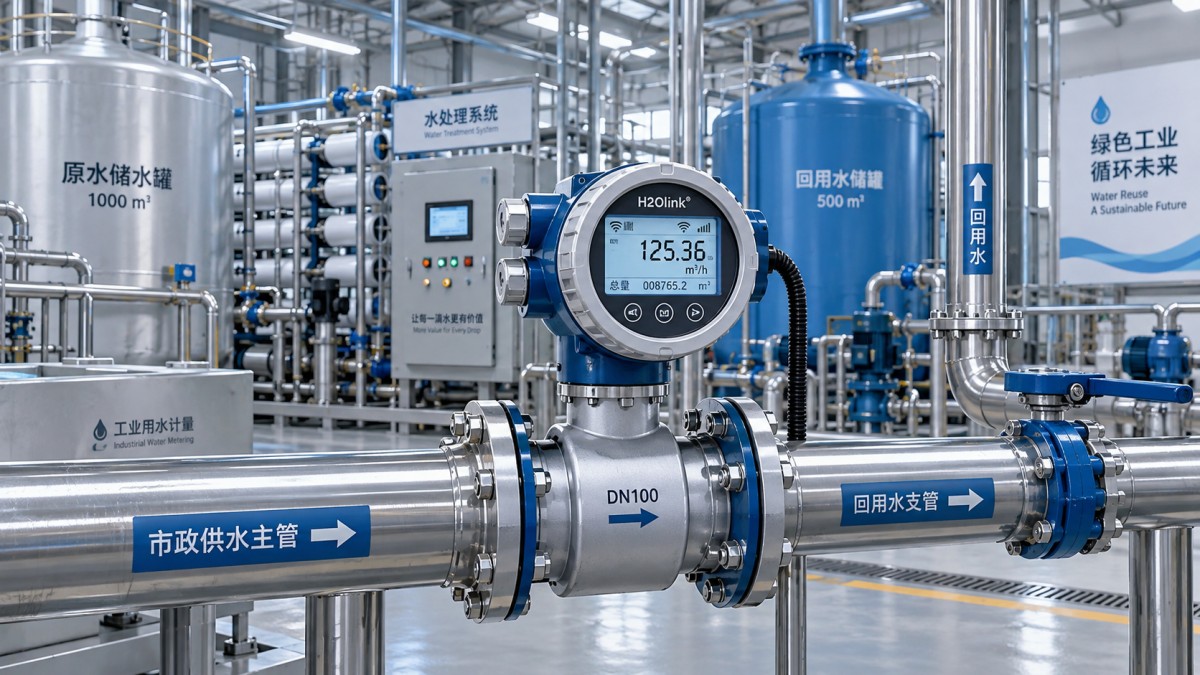
A useful metering plan begins with a water-flow map. For an industrial site, that map may include municipal supply, groundwater abstraction, surface-water intake, purchased reclaimed water, process distribution, cooling towers, wastewater treatment, reuse loops, and final discharge.
Each location answers a different reporting question. An abstraction meter supports withdrawal accounting. A discharge meter supports outflow measurement. A meter on a reclaimed-water return line shows internal circulation—but that circulating volume should not automatically be counted as a new external withdrawal.

This distinction becomes critical in industrial wastewater reclaim and zero liquid discharge systems. The same water can move through treatment and production several times. Adding every internal meter reading together can substantially overstate the site's external water demand.
Water consumption is also different from withdrawal. Under commonly used reporting approaches, consumption concerns water withdrawn that is not returned to the relevant water environment during the reporting period. Withdrawal minus discharge may support a calculation, but storage changes, transfers, destination, timing, and the applicable framework must be considered.
A practical balance therefore reconciles external inputs, outputs, storage changes, and identified consumption pathways. Evaporation, water incorporated into products, and moisture leaving in sludge or other materials may require additional measurements or documented estimates. Smart flowmeters cannot directly measure every one of these pathways.
For municipal utilities, inlet and customer-meter data can support water-loss analysis. However, the difference between water supplied and customer consumption is not automatically physical leakage. Meter under-registration, unauthorized consumption, authorized unbilled use, and timing differences also need investigation.
More readings do not necessarily mean better measurements
A faulty meter that uploads every minute creates a detailed record of a faulty measurement. Procurement teams should assess measurement performance separately from communications capability.
Match the meter to the actual operating conditions
Relevant factors include minimum and maximum flow, pipe diameter, pressure, temperature, water conductivity, suspended solids, installation geometry, and whether the pipe remains full. A meter suitable for a clean-water supply may not suit an abrasive wastewater stream or a hot process-water circuit.
Ultrasonic and electromagnetic technologies can both support digital water management, but their suitability depends on the application. Electromagnetic meters require adequate fluid conductivity. Ultrasonic performance depends on the measurement method and installation conditions; entrained air or other fluid characteristics may affect results.
Low-flow performance deserves particular attention. A meter sized around peak demand may provide weaker evidence for small overnight losses if those flows fall outside its verified operating range. Selecting a device requires the actual flow profile, not only the nominal pipe size.
Verify performance after installation
Supplier specifications are not a substitute for commissioning checks. Confirm installation requirements, flow direction, units, totalizer behavior, and agreement between local readings and transmitted values. Establish calibration or verification arrangements based on application risk, manufacturer guidance, and applicable requirements.
Standards such as ISO 4064 and relevant AWWA or EN standards can inform specifications where their scope fits the application. Referencing a standard does not establish that every installation is accurate. The selected device, installation, operating conditions, and supporting documentation must align.
For assurance purposes, retain meter identifiers, locations, commissioning records, verification results, and replacement histories. Otherwise, an apparently continuous dataset may conceal a device change, counter reset, or shift in measurement uncertainty.
Build a data trail an assurance provider can follow
The journey from a field reading to an ESG disclosure often passes through gateways, utility platforms, historians, spreadsheets, and sustainability software. Every handoff introduces opportunities for errors—even when the original measurement is sound.
A defensible system should address five controls:
- Asset identity: Associate each meter with a physical location, water stream, organizational boundary, and responsible owner.
- Data completeness: Flag communication gaps, duplicates, implausible values, and unexplained totalizer resets.
- Consistent calculations: Control units, time zones, reporting cutoffs, and aggregation rules across facilities.
- Transparent substitutions: Label estimated or reconstructed values and preserve the method used to generate them.
- Traceable revisions: Retain raw readings and an audit trail showing corrections, approvals, and calculation versions.
A communication outage does not necessarily mean the measurement is lost. Some devices retain cumulative totals or interval readings locally, allowing later recovery. Reporting teams must distinguish a transmission gap from a measurement gap before deciding how to reconstruct missing information.
Cybersecurity also affects reporting integrity. Unauthorized configuration changes, incorrect access permissions, or compromised integrations can undermine confidence in the dataset. Access controls and protected configuration histories belong alongside calibration records in the governance plan.
What smart metering contributes to water disclosures—and what it cannot prove
Frameworks such as GRI 303 and, where applicable, ESRS E3 require water-related information that extends beyond a single total. CDP questionnaires may also request water accounting, risk, and management information. Smart meters can support relevant quantitative disclosures, but organizations must map readings to the requirements of the framework and reporting period they actually use.
Source classification, facility location, and basin context usually come from other systems. A highly accurate annual withdrawal figure does not show whether the withdrawal occurred in a water-stressed area. Likewise, a flowmeter does not establish pollutant concentrations or treatment effectiveness; those require appropriate sampling, analysis, and monitoring.
Digital twins can help reconcile measured flows with expected process behavior and identify anomalies. Their outputs remain model-dependent, however. Predicted consumption should not silently replace measured consumption in a disclosure.
Claims about circularity require similar discipline. Increased internal reuse can be valuable, but its environmental benefit depends on what it displaces and the treatment resources it requires. Reduced freshwater demand should be evaluated alongside energy use, chemicals, concentrate management, and sludge handling rather than presented as an isolated sustainability success.
A practical investment sequence for reporting teams
The most effective rollout is usually targeted rather than universal. Start with the reporting questions that currently rely on weak evidence.
- Map existing disclosures to data sources. Identify which figures are measured, invoiced, estimated, or derived. Document uncertainty and ownership.
- Prioritize material gaps. Focus on major withdrawals, high-risk sites, discharge points, and processes where unexplained losses or reuse claims matter.
- Pilot the complete reporting chain. Test installation, communications, exception handling, reconciliation, and export into the ESG reporting system—not just the dashboard.
- Validate against independent evidence. Compare readings with utility records, tank-level changes, operational logs, or other suitable measurements, recognizing their own limitations.
- Scale after controls work. Expand once the organization can explain discrepancies, manage missing data, and reproduce reported totals.
Evaluate the investment against both operational and reporting needs. Maintenance, communications, integration, verification, and staff time all belong in the assessment. Potential savings from leak detection or process optimization should be assessed separately from the value of stronger disclosure evidence.
G-WIC's cross-sector benchmarking perspective is useful here: metering should be considered alongside treatment assets, conveyance systems, wastewater recovery, and residuals management. A sensor purchase is more defensible when it addresses a defined water-accounting gap than when it merely adds another connected asset.
The answer is yes—with conditions worth enforcing
Smart water meters improve ESG reporting accuracy when they replace weak estimates, capture meaningful flow boundaries, and feed a controlled reporting process. Their strongest contribution is not a polished visualization. It is the ability to explain where a number came from, how it was checked, and what it does—and does not—represent.
Before approving a rollout, ask one question: Could we reproduce and defend the reported water figure from the underlying records? If the answer is no, more connected devices alone will not solve the problem. Combine fit-for-purpose measurement with a complete water balance and accountable data governance, and smart metering becomes a credible foundation for water-related ESG disclosure.
Next :NoneRecommended News
TIME
{item.publish_time}{item.title}{item.description}auth.
{item.goods_category_sif3qfva9d}Read MoreCONTACT US