Search News
Industry Portal
Hot Articles
- Seawater Desalination System Factory Selection: 7 Mistakes That Delay CommissioningSeawater desalination system factory selection can make or break commissioning. Discover 7 costly mistakes, key checklist points, and smarter ways to compare suppliers.
- Dissolved Air Flotation (DAF) Wholesale: What to Check Beyond the Quoted PriceDissolved air flotation (DAF) wholesale is about more than price. Learn how to compare performance, materials, sludge handling, compliance, and service to avoid hidden costs.
- Choosing a Chlorination System OEM Supplier Without Creating Maintenance HeadachesChlorination system OEM supplier selection affects uptime, spares, and service costs. Learn how to avoid maintenance headaches with a practical, lifecycle-focused evaluation guide.
Popular Tags
Industry NewsAdvanced Water Treatment Solutions for Tough Industrial Effluents
auth.
Dr. Elena HydroTime
Apr 23, 2026Click Count
For industries facing complex effluents, Advanced Water Treatment solutions are no longer optional but central to cost control, Regulatory Standards compliance, and long-term resilience. From Reverse Osmosis membrane specifications to Industrial Wastewater recycling systems and Sludge Treatment equipment, decision-makers need practical insight that connects performance, Industrial Wastewater treatment cost, and Circular Economy in wastewater treatment.
Why tough industrial effluents require a different treatment strategy

Not all wastewater behaves the same. High-salinity brine, emulsified oil, dye-bearing streams, heavy-metal rinse water, pharmaceutical residues, food-processing organics, and landfill leachate each challenge treatment systems in different ways. A conventional single-stage approach often fails when influent quality swings over 20%–40% within a week, when discharge permits tighten, or when water reuse becomes part of plant economics.
For operators and project managers, the main issue is stability. A plant may meet target performance in a controlled trial, yet struggle under 24/7 production with pH variation, surfactants, scaling ions, temperature changes, and shock loads. This is where advanced water treatment matters: it combines pretreatment, membrane separation, polishing, sludge management, and monitoring into a controllable process rather than a collection of disconnected units.
For decision-makers, the challenge is broader than compliance. Industrial wastewater treatment cost depends on energy, chemicals, membrane replacement cycles, sludge disposal, labor, downtime, and reject management. In water-stressed regions, reuse can offset freshwater intake within a 2–5 year planning horizon. In ESG-driven sectors, reclaim rates and ZLD readiness now influence site selection, permitting confidence, and investor scrutiny.
G-WIC supports this decision process with cross-sector benchmarking across utility-scale treatment, Industrial Wastewater reclaim and ZLD systems, high-pressure conveyance hardware, digital water platforms, and sludge valorization. That multidisciplinary view is critical because tough industrial effluents rarely fail due to one component alone; they fail when process, materials, control logic, and compliance planning are not aligned from the start.
What usually makes an effluent “tough” in procurement terms?
From a procurement and engineering perspective, difficult wastewater usually combines at least 3 risk factors: high COD or TOC, high TDS, toxic or inhibitory compounds, unstable flow, or costly sludge generation. Once two or more appear together, solution selection becomes less about unit price and more about lifecycle compatibility.
- High dissolved salts increase osmotic pressure and often push systems toward nanofiltration, high-pressure RO, brine concentration, or thermal stages.
- Oil, grease, colloids, and surfactants raise fouling risk and make pretreatment quality more important than membrane brand alone.
- Heavy metals and hazardous residues elevate sludge classification, transport, and disposal costs, which can materially change total project economics.
- Variable production cycles require control flexibility, equalization capacity, and instrument reliability rather than a fixed design-point mindset.
Which advanced water treatment technologies fit which industrial conditions?
Technology selection should start with contaminants, reuse target, discharge limit, and concentrate strategy. In practice, most industrial systems use 4 functional layers: conditioning, separation, polishing, and residuals handling. The best design is usually not the most complex one, but the one that keeps recovery, cleaning frequency, operator burden, and sludge volume in balance.
RO remains central in advanced water treatment because it enables high-quality reuse for boiler feed, cooling makeup, process washdown, and utility applications. However, RO performance depends heavily on upstream solids control, hardness management, oxidant protection, and cleaning regime. A robust membrane line often needs consistent SDI control, stable pH windows, and pressure management over the full operating cycle.
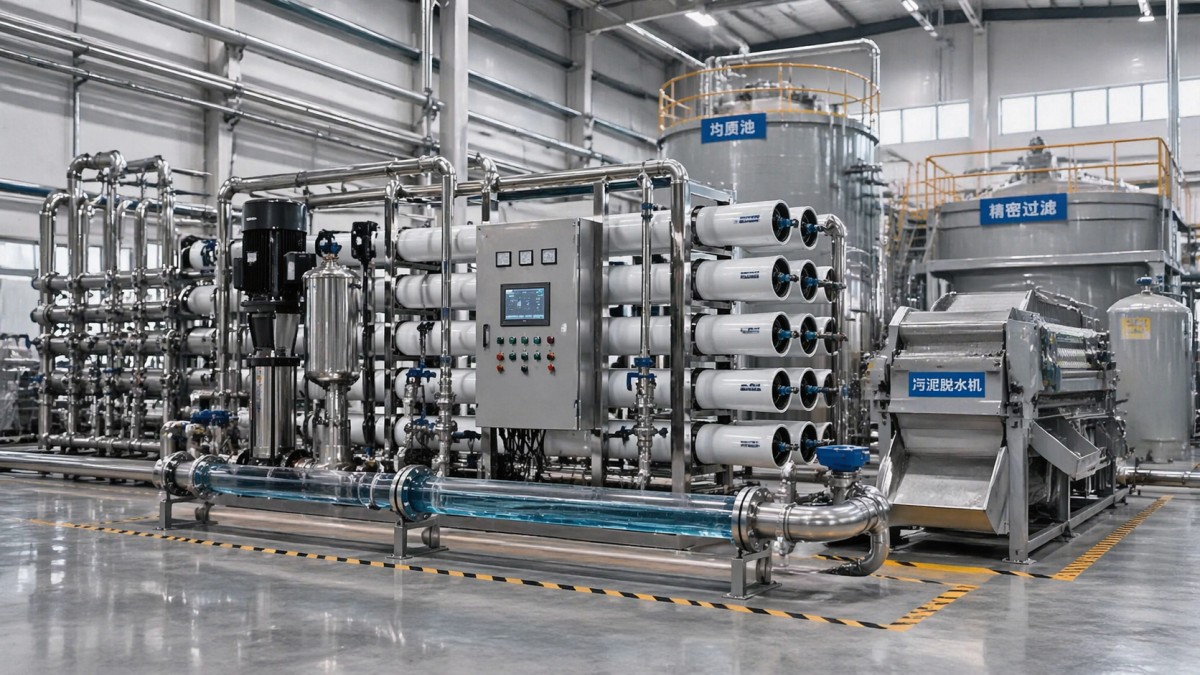
When salinity or organics exceed the practical limits of membrane-only recovery, hybrid trains become more attractive. These may include dissolved air flotation, ultrafiltration, biological treatment, activated carbon, ion exchange, evaporators, crystallizers, or advanced oxidation. Sludge treatment should not be treated as an afterthought. Dewatering, thermal drying, and beneficial use pathways can reduce disposal frequency from weekly hauling to a more manageable batch schedule depending on solids content and local regulation.
The table below compares common advanced water treatment routes used across sectors such as chemicals, textiles, food and beverage, metal finishing, electronics, pharmaceuticals, energy, and municipal-industrial interfaces.
The comparison shows why no single process is universally optimal. For example, UF + RO can be highly effective for reuse, but if the feed has persistent oil carryover or silica scaling, the membrane replacement cycle may shorten significantly. By contrast, a ZLD line can improve water sovereignty and compliance resilience, yet it raises energy intensity and demands tighter upstream control of antiscalant, pH, and solids carryover.
Typical technical checkpoints before final design
Core data that should be confirmed over 2–4 weeks
Short-term grab samples are not enough for difficult wastewater. A reliable selection process should examine flow fluctuation, pH range, conductivity, TSS, COD, oil and grease, hardness, silica, key metals, and cleaning chemical compatibility over at least 2–4 weeks or across a full production cycle. Seasonal variation can also matter for intake water, cooling load, and discharge temperature.
- Confirm whether the target is discharge compliance, partial reuse, high-recovery reuse, or ZLD.
- Check if equalization volume covers peak events of 4–8 hours or only average flow.
- Review whether instrumentation supports continuous monitoring or only periodic manual sampling.
- Assess sludge handling capacity together with water treatment, not after procurement is closed.
How to evaluate performance, cost, and lifecycle risk before buying
Many buyers focus first on installed cost, but tough industrial effluents punish narrow evaluation. A lower-capex skid can become more expensive within 12–24 months if it consumes more chemicals, requires frequent membrane cleaning, generates unstable sludge, or cannot maintain output during feed variability. For distributors and EPC teams, this is also where post-sale service exposure often begins.
A more reliable approach is to compare at least 5 cost layers: civil and equipment scope, utilities, chemicals, consumables, residuals disposal, and downtime risk. Water tariff trends and freshwater scarcity should also be included. In regions where industrial water prices fluctuate sharply or extraction permits tighten, reuse economics can improve faster than many feasibility models assume.
G-WIC’s strength is especially relevant here because technical benchmarking alone does not answer commercial timing. Project tenders, utility rates, ESG policy shifts, and standards alignment all affect the real value of an advanced water treatment project. That wider lens helps teams decide whether to phase a system in 2 stages, overdesign critical pretreatment, or prioritize modular expansion.
The procurement table below can be used as a practical filter before RFQ issuance or vendor shortlist reduction.
This framework helps different stakeholders ask better questions. Operators can focus on cleaning intervals, alarms, and consumables. Safety and quality personnel can focus on permit reliability and handling risks. Executives can compare payback sensitivity under different water tariff, production, and compliance scenarios. When these perspectives are aligned early, supplier comparisons become far more meaningful.
A practical 4-step buying sequence
- Define the compliance and reuse endpoint first, not the preferred equipment type.
- Collect representative feed data across normal, peak, and upset conditions for 2–4 weeks.
- Compare vendors on lifecycle metrics, not only on capital quotation and nameplate capacity.
- Validate implementation scope, operator training, spares plan, and residuals handling before contract award.
What standards, monitoring, and implementation details are often overlooked?
Advanced water treatment projects often underperform because teams focus on process flow diagrams but underestimate standards interpretation, mechanical details, and data architecture. For industrial users, compliance is rarely one document. It involves discharge parameters, reuse quality, chemical handling rules, equipment materials, safety procedures, and documentation suitable for audit or customer review.
International references such as ISO-related management frameworks, AWWA practice references, and EN-based material or equipment expectations can support specification quality, even when local permits remain the legal basis. The value is consistency. Standardized benchmarking helps compare membranes, tanks, piping, flow measurement, and sludge drying equipment on a more disciplined basis instead of relying on generic performance language.
Digital monitoring is increasingly decisive. Smart ultrasonic flowmeters, conductivity tracking, pressure trending, tank level sensing, and digital twin platforms can identify fouling, leakage, and abnormal recovery loss before these become major failures. In plants running continuous shifts, early warning can protect both compliance and maintenance budgets. A monitoring interval of real-time or near-real-time is fundamentally different from a once-per-shift manual check.
Implementation should also be staged. A realistic industrial project often moves through 3 phases: data validation and design basis, pilot or engineering confirmation, and full-scale deployment with operator training. Depending on complexity, standard packaged systems may move faster, while high-recovery reclaim or ZLD systems can require longer engineering, utility integration, and commissioning windows.
Common mistakes across industries
What operators and buyers most often miss
- Assuming membrane recovery targets from low-fouling feedwater can be copied directly to complex industrial streams.
- Ignoring sludge mass balance when comparing chemical pretreatment alternatives.
- Selecting hardware without checking corrosion exposure from chlorides, cleaning agents, and temperature swings.
- Underestimating the importance of spare parts, cleaning chemicals, and operator training for the first 6–12 months.
- Treating digital instrumentation as optional, even when uptime and compliance reporting depend on continuous records.
These issues matter across all industries because water reuse, discharge control, and sludge handling increasingly intersect with ESG reporting, operational resilience, and customer qualification. The more critical the site, the less tolerance there is for unverified assumptions.
FAQ: selecting advanced water treatment for industrial wastewater
How do I know if RO is enough, or if I need ZLD?
Start with the discharge limit, reuse requirement, and concentrate disposal pathway. If reject can be legally and economically managed, RO with proper pretreatment may be sufficient. If disposal is restricted, water scarcity is severe, or corporate policy requires maximum recovery, a ZLD-oriented design becomes more relevant. The choice depends on site constraints, not only on treatment ambition.
What should be tested before procurement?
At minimum, confirm a representative range for flow, pH, TDS, TSS, COD, oil and grease, hardness, silica where relevant, temperature, and any critical metals or solvent traces. For variable plants, testing over 2–4 weeks is more reliable than isolated samples. Cleaning compatibility and sludge dewatering behavior are also worth checking before final equipment selection.
Which factors most affect industrial wastewater treatment cost?
The main cost drivers are pretreatment chemical use, energy demand, membrane or media replacement, sludge disposal, labor intensity, cleaning downtime, and reject handling. In some projects, residuals management changes the business case more than the core treatment skid. That is why cost comparison should include lifecycle rather than purchase price only.
How long does implementation usually take?
Packaged polishing or reuse systems can move faster, while integrated reclaim and ZLD projects take longer because they involve utility coordination, civil work, controls, and operator training. A practical schedule usually includes 3 stages: design basis confirmation, fabrication or integration, and commissioning. Exact timing depends on feed complexity, materials, instrumentation scope, and local approval requirements.
Why work with G-WIC when planning advanced water treatment solutions?
G-WIC is built for organizations that need more than product brochures. Our institutional advantage lies in connecting water technology performance with regulatory context, commercial timing, and circular-industrial strategy. That means decision-makers can evaluate RO membranes, smart flow measurement, piping and storage materials, sludge treatment options, and ZLD pathways as parts of one infrastructure system rather than isolated purchases.
Because we benchmark across five industrial pillars, we can support discussions that matter in real projects: whether pretreatment should be strengthened before membrane investment, how conveyance hardware affects reliability under aggressive chemistries, when digital twin visibility improves operator response, and how sludge valorization may influence total cost. This is especially useful for multinational groups, EPC teams, utilities, and industrial sites facing parallel compliance and reuse pressures.
If you are evaluating advanced water treatment solutions for tough industrial effluents, contact us for parameter confirmation, process route comparison, RO and reclaim system selection, sludge handling options, likely delivery scope, standards alignment, and quotation preparation support. We can also help structure your vendor evaluation around recovery target, residuals strategy, instrumentation, and long-term operating risk.
Bring your current water analysis, target reuse quality, operating hours, and project timeline. With those 4 inputs, it becomes easier to identify whether you need a compact upgrade, a phased reclaim program, or a broader circular water infrastructure roadmap.
- Water Infrastructure
- Circular Economy
- Water Treatment
- Industrial Wastewater
- Digital Twin
- Sludge Treatment
- Reverse Osmosis
- Ultrasonic Flowmeters
- Water Scarcity
- Industrial Water
- Project Tenders
- Regulatory Standards
- Technical Benchmarking
- Water Treatment technologies
- Reverse Osmosis membrane specifications
- Circular Economy in wastewater treatment
- Advanced Water Treatment solutions
- Industrial Wastewater recycling systems
- Sludge Treatment equipment
- Industrial Wastewater treatment cost
- Regulatory Standards compliance
Recommended News